Showing posts with label currency. Show all posts

Saturday, December 22, 2012

Welcome to the money of the future: GOLD

Fancy a chunk? No, it's not chocolate... It's a solid gold bar you can break up (and could be the future of money if there's economic meltdown)

  • Swiss refinery marketing gold bar that can be easily broken into 1g chunks to be used as payment in a crisis
  • Wealthy individuals in Switzerland, Austria and Germany said to be lining up to buy the gold 'CombiBars'
  • Value of gold has gone up more than 500 per cent since 2001

By DAMIEN GAYLE
DAILYMAIL
December 21, 2012

With Christmas coming, sales of chocolate gold coins have no doubt soared as parents get ready to fill their little ones' stockings with edible treasure. But wealthy individuals worried about what the New Year could bring are instead stocking up on gold chocolate bars.

Swiss refinery Valcambi has been selling its CombiBar to private investors in Switzerland, Austria and Germany who are worried about a return of Weimar Republic-style hyperinflation.

Gold chocolate bar: An employee divides a gold Combibar at a plant of gold refiner and bar manufacturer Valcambi in the southern Swiss town of Balern. Sales have soared amid economic uncertainty in Europe  An employee shows a 1 gram piece of a gold Combibar
Gold chocolate bar: An employee divides a gold Combibar at a plant of gold refiner and bar manufacturer Valcambi in the southern Swiss town of Balern. Sales have soared amid economic uncertainty in Europe

Crisis currency: Swiss refinery Valcambi has been selling its CombiBar to private investors in Switzerland, Austria and Germany who are worried about a return of Weimar Republic-style hyperinflation

The size of a credit card, the 50g gold CombiBars are easily be broken into one gram pieces to be used as money in times of crisis. Now the company wants to bring them to market in the U.S. and build up sales in India - the world's largest consumer of gold, where it has long served as a parallel currency.

Investors worried that inflation and financial market turmoil will wipe out the value of their cash have poured money into gold over the past decade. Prices have gained almost 500 per cent since 2001 - compared to a 12 per cent increase in MSCI's world equity index, a benchmark for the value of the world's business investments.

Sales of gold bars and coins were worth almost $77billion in 2011, up from just $3.5billion in 2002, according to data from the World Gold Council.

Stocking filler for the wealthy: The divisible gold bar has a purity of 99.9 percent, weighs 50 grams and also has predetermined breaking points which allow it to be easily separated into 1g pieces without any loss of material

'The rich are buying standard bars or have deposits of physical gold. People that have less money are buying up to 100 grams,' said Michael Mesaric, CEO of Valcambi. 'But for many people a pure investment product is no longer enough. They want to be able to do something with the precious metal.'

Mr Mesaric said the advantage of the CombiBar - dubbed a 'chocolate bar' because pieces can be easily broken off by hand - is that it is easily carried and is cheaper than buying 50 one gram bars. 'The produce can also be used as an alternative method of payment,' he said.

Valcambi, a unit of U.S. mining giant Newmont, is building a sales network in India and plans to launch the CombiBar on the U.S. market next year. In Japan, it wants to focus on CombiBars made of platinum and palladium. In Europe, demand is particularly strong among the Germans, still scarred by post-World War One hyperinflation, when money became all but worthless and it took a wheelbarrow full of notes to buy a loaf of bread.

'Above all, it's people aged between 40 and 70 that are investing in gold bars and coins,' said Mr Mesaric. 'They've heard tales from their parents about wars and crises devaluing money.'
The CombiBar is particularly popular among grandparents who want to give their grandchildren a strip of gold rather than a coin, said Andreas Habluetzel, head of the Swiss business of Degussa, a gold trading company.

'Demand is rising every week,' Mr Habluetzel said. 'Particularly in Germany, people buying gold fear that the euro will break apart or that banks will run into problems.' Stephan Mueller, who manages bank Julius Baer's $6billion gold fund, said one problem with using gold as a method of payment is that people have to take its value on blind trust.

'Gold is a useful store of value,' Mr Mueller said. 'However I doubt whether it will succeed as a method of payment.' Nonetheless, as developments in the euro zone lurch from one crisis to another, demand for gold that can be sold in vending machines is also growing.

'Sales rise according to the temperature of the crisis,' said Thomas Geissler, whose firm Ex Oriente Lux operates 17 gold vending machines in Europe, the U.S. and the United Arab Emirates. The machines saw record sales in 2010, one day after the then Deutsche Bank CEO Josef Ackermann raised doubts over whether Greece would be able to pay its debts. Since the launch of the machines, which operate under the name 'GOLD to go', 50,000 customers have withdrawn more than 21million euros in gold. The average buyer is male, over 50 years old and well off.
'
Customers are hoarding gold mostly at home as a precaution against a crisis, just as their fathers and grandfathers did before them,' Mr Geissler said.

Friday, February 10, 2012

The U.S. Federal Reserve: What we Americans ought to know

10 Things That Every American Should Know About The Federal Reserve
The Economic Collapse
Thursday, February 9, 2012

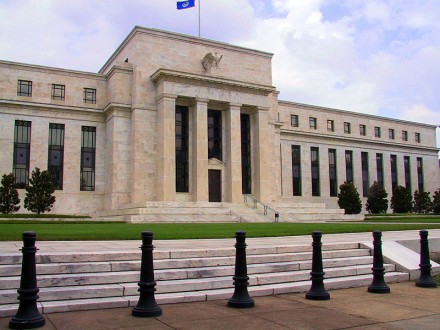
The U.S. Federal Reserve, Credit: TheEconomicCollapse
What would happen if the Federal Reserve was shut down permanently? That is a question that CNBC asked recently, but unfortunately most Americans don't really think about the Fed much. Most Americans are content with believing that the Federal Reserve is just another stuffy government agency that sets our interest rates and that is watching out for the best interests of the American people. But that is not the case at all. The truth is that the Federal Reserve is a private banking cartel that has been designed to systematically destroy the value of our currency, drain the wealth of the American public and enslave the federal government to perpetually expanding debt. During this election year, the economy is the number one issue that voters are concerned about. But instead of endlessly blaming both political parties, the truth is that most of the blame should be placed at the feet of the Federal Reserve. The Federal Reserve has more power over the performance of the U.S. economy than anyone else does. The Federal Reserve controls the money supply, the Federal Reserve sets the interest rates and the Federal Reserve hands out bailouts to the big banks that absolutely dwarf anything that Congress ever did. If the American people are ever going to learn what is really going on with our economy, then it is absolutely imperative that they get educated about the Federal Reserve.

The following are 10 things that every American should know about the Federal Reserve.... [Click here to read them all]

Wednesday, February 1, 2012

Current U.S.-Iran Tensions: Is there more than meets the eye...again? Reminiscent of Iraq and Libya...

Here we go again, are we that naive to think that yet again the current tensions with Iran is really about 'nukes'? Come on, it all about the precious black gold we call OIL, its always about oil. In 2000, Saddam Hussein of Iraq wanted to turn away from trading oil in U.S. dollars to euros instead. Of course that wouldn`t be allowed to befall the powerful dollar and he was subsequently attacked and removed in 2003. In 2011, Col Muammar Ghadafi of Libya envisioned to create a new Gold dinar currency, a currency that would be backed by gold, inevitably rivaling the dollar and euro and allow Ghadafi to re-price oil. It would have had serious consequences for the world financial system - i.e. the world elite, even though it would have empowered the people of Africa for once in their lives and not be dictated by the global powers into debt slaves and destitute. 


An oil field near Pol-e-Dokhtar, Iran
An oil field near Pol-e-Dokhtar, Iran; credit: RT News
Petrodollar pumping US policy on Iran, backfire looms
by: Michael T. Winter
RT News
published: 01 February, 2012, 20:18

As tensions between the US and Iran heat up, author Michael T. Winter believes the main reason behind America’s harsh stance is Tehran’s move to seek an alternative to the dollar as an oil currency.

Economic sanctions, spearheaded by the US and, less willingly, the EU could have a disastrous effect on both of their respective economies. If Iran cannot sell their oil to Europe, there are plenty of customers waiting in the wings, and if they come bearing not petrodollars, but gold and sovereign currencies, then all the better for Iran. These sanctions, if enforced, will in effect place a serious dent in the power of the petrodollar.

...At the heart of the issue is not Iran’s dubious attempt to build nuclear weapons, or even oil, but how that oil is paid for. In 1973, Richard Nixon promised King Faisal of Saudi Arabia that the US would protect Saudi Arabian oilfields from any and all interested parties seeking to forcefully wrest them from the House of Saud. It’s important to remember that in 1973, Saudi Arabia didn’t have a fraction of the military and ground forces it possesses today (almost exclusively US manufactured weapons) and the USSR was very much a threat.

In return Saudi Arabia, and by extension OPEC, agreed to sell their oil in US dollars only. As if that weren’t sweet enough, as part of the deal, they were required to invest their profits in US treasuries, bonds and bills. The real zinger is that all countries purchasing oil from OPEC had to do so in US dollars, or ‘petrodollars’.

...2001, enter Saddam Hussein. He floated a plan to sell oil for European currencies in lieu of petrodollars. Shortly after Iraq was ‘suddenly’ found to be seeking and stockpiling weapons of mass destruction – allegations spearheaded by the US. The world knows what happened, suffice it to say that Saddam is dead and Iraq is ‘back on track’, selling its oil for petrodollars once again.

...Gaddafi made a fatal error when he decided to move away from the petrodollar in favor of other currencies. This simply was not tolerated by the US. Having already played the WMD card in Iraq, something new was pulled from the US ‘regime change’ grab bag. Within a year, ‘internal’ elements rose up in rebellion against Gaddafi and now he is dead. Long live the petrodollar.

Dominique Strauss-Kahn, former head of the International Monetary Fund (IMF), suggested last year that the Euro would be a more suitable oil reserve currency than the US Dollar. Within three months of that statement, allegations of rape ruined his career, derailing his bid for the French Presidency in the process. Soon thereafter, all charges were dropped, but of course, le dommage était fait – the damage was done. Christine Lagarde, DSK’s replacement as head of the IMF sees no reason to change the current arrangement, naturellement.

The Iran situation is a little trickier. The US has sought to dismantle Iran’s regime ever since the 1979 Iranian Revolution, so this round of hostilities, while not new, reflects a new level of intensity. Why, after thirty years of hostility, has the US ratcheted up its rhetoric? As Obama stated in his recent State of the Union address, when it comes to Iran and the insistence they dismantle their nuclear program, “no options are off the table”. By stating ‘no options’ this would include nuclear deployment as a deterrent.

The answer of course is that Iran is now seeking to disengage itself from the petrodollar dynamic. In 2005, Iran sought to create an Iranian Oil Exchange, thus bypassing the US controlled petrodollar. Fear that western powers would freeze accounts in European and London banks put an end to that plan.

...Iran is breaking the back of the petrodollar. Others have tried, but Iran is succeeding. To understand how disastrous this is for the US, one must have a basic understanding of how critical a role the petrodollar plays in the economic health of the US.

...By creating the petrodollar paradigm, the US economy soared, as all countries of the world were required to amass US currency to purchase oil from OPEC nations. Sales of T-bills, securities and US bonds soared. US coffers fattened. With the US dollar as the world’s oil currency reserve, economic fortune favored the US. But with great reward comes great risk. While other countries exchanged their currency for the dollar, (forfeiting value in the process) the US simply printed more money to match their needs and purchase their oil – essentially for free. The best example is that while gasoline in the US cost $3.00 per gallon, in Europe that same gallon costs $6.00 or more.

Herein lies the danger. If Iran is successful in its bid to set up their own bourse, or oil exchange, then what need does the world have for all those US dollars? The answer is none at all. As Iran creating gold and sovereign currency partnerships with India, China, South Korea and Russia, the hegemony of the petrodollar will be destroyed.

The resulting sell-off of US dollars, T-bills, securities, bonds and assets will flood the already swollen world economy with even more useless dollars, ultimately devaluing it into a position where hyper-inflation becomes a risk.

So, while the US government sabre-rattles and prattles on and on about nuclear weapons and the threat Iran poses to the Middle East, the thin veneer of lies spouted by the elite controlled media is being stripped away, revealing the truth of their warmongering rhetoric.

...The US, by their foolish insistence on enforcing embargoes and sanctions against Iran, is hastening the end of the petrodollar and ushering in the age of US dollar hyper-inflation. A practical example: One loaf of bread in a healthy economy is $1.00. In an inflationary economy it’s $1.75. In a hyper-inflationary economy, $500.00.


Bullies may be large and dangerous, but rarely are they intelligent.

Damocles wisely vacated the throne of Dionysius before the sword fell upon his head, but the US is foolishly refusing to step down from their economic dais in spite of the catastrophic effect current policy direction will mean for US citizens and the world economy.

Michael T. Winter

The statements, views and opinions expressed in this article are solely those of the author and do not necessarily represent those of RT.

(click here to read the full article by Michael Winter)


Additional info:The Real Reasons Why Iran is the Next Target: The Emerging Euro-denominated International Oil Marker
by William Clark
www.globalresearch.ca