Showing posts with label U.S.. Show all posts

Friday, April 5, 2013

The Unfair Biased Treatment of the DPRK (North Korea)

Putting the Squeeze on North Korea
By Gregory Elich

Global Research,
February 04, 2013

Tensions are escalating since North Korea’s launch of a satellite into orbit on December 12, 2012. Overwrought news reports termed the launch a “threat” and a “provocation,” while U.S. National Security Council spokesman Tommy Vietor called it “irresponsible behavior.” Punishment for North Korea was swift in coming.

North Korea’s Kwangmyongsong-3 was just one of 75 satellites that a variety of nations sent into space last year, but Pyongyang’s launch, and a failed launch earlier in the year on April 12, were the only ones singled out for condemnation. [1] In Western eyes, there was something uniquely threatening about the Kwangmyongsong-3 earth observation satellite, unlike the apparently more benign five military and three spy satellites the United States launched last year.

We are told that the Democratic People’s Republic of Korea (DPRK, the official name for North Korea) used the satellite launch to test ballistic missile technology. But the North Koreans could hardly have sent their satellite into orbit by slingshot. The Kwangmyongsong-3 was equipped with a camera intended to help assess the nation’s natural resources and forest distribution and to collect crop estimates. The Western press was quick to scoff at the satellite as having no rational economic purpose. Although the satellite failed to become operable, a common enough experience for nations putting their first satellite into space, the intent was to support much-needed ecological recovery in North Korea and to aid agricultural planning.

Specialists argue that the DPRK’s Unha-3 missile, used for the launch, is not a suitable candidate for delivering a nuclear warhead. According to analyst Markus Schiller of Schmucker Technologie in Germany, for North Korea to “become a player in the ICBM game, they would have to develop a different kind of missile, with higher performance. And if they do that seriously, we would have to see flight tests every other month, over several years.” [2] The North Korean missile “was developed as a satellite launcher and not as a weapon,” Schiller says. “The technology was suited only for satellite launch.” Brian Weedan, a space expert at the Secure World Foundation, agrees, and points out that the missile took a sharp turn to avoid flying over Taiwan and the Philippines. “That is definitely something more associated with a space launch than with a ballistic missile launch. It’s not what you would expect to see with a missile test.” [3]

The Unha-3 is simply too small for the job of delivering a nuclear warhead, even assuming that the DPRK had miniaturized a nuclear bomb, an endeavor requiring significant time and effort. The North Koreans would also need to develop a long-range guidance system and a reentry vehicle capable of withstanding the heat of returning through the atmosphere. Experts consider the DPRK to be years away from achieving such steps. [4]

In regard to North Korea’s satellite launches, Lewis Franklin and Nick Hansen of Stanford University’s Center for International Security and Cooperation remark, “The oft-repeated phrase ‘readily convertible to an ICBM’ posed by non-technical policy experts is engineering-wise unsupportable.” They explain that while other nations have utilized ICBMs for sending satellites into space, conversion of a light missile like the Uhha-3 into an ICBM “requires considerable redesign and testing, and no country has taken this route.” [5]

The other aspect of the launch that the U.S found so provocative was its violation of UN Security Council Resolution 1874 of June 12, 2009, which enjoined the DPRK from conducting “any launch using ballistic missile technology.” That resolution was prompted by a North Korean nuclear test. Yet, when Israel, Pakistan and India – all non-signatories to the Nuclear Non-Proliferation Treaty – not only performed testing, but proceeded to build substantial nuclear arsenals and missiles capable of delivering nuclear payloads, no action was forthcoming. This double standard has not gone unnoticed in the DPRK, which understands that the distinction between the North Korean case and that of Israel, Pakistan and India hinges on the latter three nations being U.S. allies, while for decades it has been the target of Western sanctions, threats and pressure.

Interestingly enough, India and Pakistan tested nuclear weapon-capable ballistic missiles at around the time of North Korea’s failed satellite launch on April 12, 2012. [6] The Indian and Pakistani missiles did not carry satellites; these were purely military tests, a fact which did not perturb the Obama Administration. Criticism was reserved for North Korea alone, while in regard to India’s test, U.S. State Department spokesman Mark Toner merely noted that the U.S. has a “very strong strategic and security partnership with India.” [7] Following Pakistan’s launch, U.S. State Department spokeswoman Victoria Nuland’s only comment was, “What’s most important is that they do seem to have taken steps to inform the Indians.” [8] These mild remarks contrasted with the vociferous abuse poured upon North Korea for its non-nuclear capable missiles carrying satellites.

Since the April ballistic missile launches, India and Pakistan have continued their tests, including India’s test of a nuclear-capable ballistic missile fired from underwater, part of its program to develop submarine-based nuclear missiles. [9] India conducted its underwater ballistic missile test on January 27, only a few days after the UN Security Council imposed sanctions on North Korea for putting a satellite into orbit.

When North Korea launched its satellite, India condemned the launch as “unwarranted,” and termed it an action adversely impacting peace and stability. [10] That same day, India test fired its nuclear-capable Agni-I ballistic missile, again without complaint by the U.S. [11] And just days after passage of the UN Security Council resolution against the DPRK, Japan put two spy satellites into space, both aimed at North Korea. [12] Not surprisingly, these missile launches evoked no complaint from U.S. officials.

South Korea successfully placed its own satellite into orbit on January 30, 2013, with the complete support of the U.S., which only added to North Korea’s growing sense of irritation over the blatant double standard. The hypocrisy is quite breathtaking. The U.S. sits atop the world’s largest nuclear arsenal, possesses the largest military machine on earth, regularly invades or bombs other nations, threatens nations who refuse to bend to its will, turns a blind eye to tests of ballistic missiles by India, Pakistan and Israel, and it condemns the small nation of North Korea for engaging in “provocative” behavior by sending a peaceful satellite into space.

The DPRK bears the distinction of being the only nation to have a UN Security Council resolution in effect banning it from launching a satellite. Yet, the international outer space treaty affirms that outer space “shall be the province of all mankind,” and that “Outer space, including the moon and other celestial bodies, shall be free for exploration and use by all States without discrimination of any kind.” [13] Note the language used here: “without discrimination of any kind.” This is absolutely unambiguous. The treaty does not say “except when the powerful choose to deny this right to a small nation.”

Western analysts argue that when a UN Security Council resolution contradicts international law, it is the resolution that takes precedence. That view makes a mockery of international law, which ceases to have any meaning when it can be discarded at will by imperial dictate.

The UN Charter tasks the Security Council to deal with matters relating to “threats to the peace, breaches of the peace, or acts of aggression.” The DPRK Central Committee of the Workers Party of Korea explains that its satellite launches for peaceful purposes “bear no relationship with the issues of international peace and security.” Moreover, the Security Council has never seen fit to take issue with such nations as the United States and Japan “that are speeding up militarization by launching innumerable spy satellites.” [14]

Sensing that the DPRK’s impending satellite launch would present a welcome opportunity, the U.S. started lining up support for imposing further sanctions on the DPRK well before the launch took place. Already the most heavily sanctioned nation on earth, North Korea’s economy could only suffer more damage from new sanctions. That was precisely the Obama Administration’s aim.

In anticipation of North Korea’s missile launch, South Korea under the ever-hostile administration of Lee Myung-bak, worked with other nations to identify the few remaining international bank accounts held by North Korea which had not yet been closed due to U.S. pressure. The hope was that North Korea could be completely blocked from engaging in international trade. The Lee Administration, too, perceived the missile launch as an opportunity to inflict further economic damage on its neighbor to the north. [15]

The Chinese advocated resuming the six-party talks, which were last held in December 2008. “China really believes that we ought to re-engage with North Korea,” U.S. Ambassador to China Gary Locke remarked, but “we don’t believe that we should be rewarding their bad behavior by sitting down and talking with them.” U.S. diplomats adamantly ruled out talks. During negotiations in December 2012, U.S. Ambassador to the UN Susan Rice bluntly told a Chinese diplomat that his nation’s resistance to additional sanctions was “ridiculous.” Rice demanded that North Korea face “consequences” for its satellite launch. [16]

U.S. officials are fond of saying that they will not reward the DPRK for its “bad behavior” by talking with its officials, but one cannot help but wonder: just whose behavior is bad? North Korean officials, whose nation exercised its right under international law and put a peaceful satellite into orbit, a right granted to all nations, and who want dialogue, or U.S. officials, who petulantly refuse to engage in negotiations, and who only know how to bully and intimidate?

The first task was to get China onboard with the concept of imposing new sanctions on its neighbor. High-ranking U.S. and South Korean diplomats met with their Chinese counterparts in Beijing on December 17, 2012. The Chinese opposed sanctions, preferring a prudent response. “The Chinese side repeated its stance that it wants to keep peace and stability on the Korean Peninsula,” a South Korean diplomatic source revealed. But the U.S. had “a strong willingness” to impose sanctions. “The U.S. is also sending a message to China that it will have no choice but to beef up its military readiness against North Korea’s threats unless a resolution is adopted at the U.N. Security Council.” [17]

The United States had already taken a number of steps to increasingly militarize its relations with South Korea in recent months, and it is probable that the threat to expand the U.S. military presence in the region finally persuaded the Chinese to back UN sanctions, despite their inevitable destabilizing effect. A U.S. military buildup in the region would serve a double purpose, aimed not only at North Korea but surely China as well. The Chinese were also keen to avoid straining relations with the U.S, an important trading partner.

Once the U.S. and South Korea won Chinese agreement for a UN Security Council resolution, the Obama Administration had a wish list of harsh measures that it wanted to implement via the resolution. U.S. State Department spokeswoman Victoria Nuland announced that the Obama Administration’s plan was “to continue to increase the pressure on the North Korean regime. And we’re looking at how best to do that, both bilaterally and with our partners going forward. Until they get the message, we’re going to have to continue to further isolate this regime.” Responding to a reporter who commented that North Korea “has long wanted direct talks with the U.S.,” and asked if the U.S. would consider that or stick to the six-party format, Nuland dismissively replied, “We and our partners are not in the business of rewarding them.” [18] There would be no talks of any kind.

U.S. negotiators insisted that the UN Security Council pass a resolution rather than a presidential statement, so that it would carry more force. Under pressure, the Chinese relented. The specific sanctions to be imposed were another matter. There the Chinese were more successful. The U.S. wanted to maximize the damage that would be inflicted on the North Korean people. Chinese Ambassador to the UN Li Baodong said, “The initial draft prepared by the UNSC contained a number of sanctions, but China believed that such measures would not be helpful in defusing the situation and would only cause harm to the North Korean economy and the lives of its people. As a result of more than a month of protracted negotiations, these provisions were removed from the final draft of the resolution.” [19]

UN Security Council resolution 2087 passed unanimously on January 22, 2013, ordering the DPRK to cease launching satellites, and that “any further such activities” would result in its “determination to take significant action.” A number of measures were imposed, including travel bans and asset freezes on specified individuals involved in the DPRK’s space program and banking officials assisting in its financial dealings. Asset freezes were also slapped on the North Korean Committee for Space Technology and North Korean banks and firms involved in the space program, essentially blocking those organizations from engaging in normal international financial transactions. [20]

The U.S. and South Korea immediately began planning further sanctions that they could impose on a bilateral basis. The U.S. had already stopped food aid to North Korea many months beforehand. Among the alternatives the U.S. and South Korea discussed were stepping up inspections of North Korean ships and ways to hamper North Korean ships from travelling near the Korean Peninsula. [21] The U.S. Treasury Department wasted little time in implementing its first set of bilateral sanctions, acting the day after passage of the UN Security Council resolution. It announced that all assets under U.S. control would be frozen held by two North Korean bankers and Hong Kong-based Leader International Trading Limited. [22]

South Korea had already revised its Public Order in Open Ports Act so that it required entry clearance for container ships having visited a North Korean port during the prior 180 days; an increase from the earlier 60 day limit. A South Korean official said that Seoul intended to target shipments into and out of the DPRK. “We are considering sanctions in marine transport. Now that we have already set the legal grounds, we will start talks with other countries over additional sanctions.” [23] The intention is to cut maritime supply routes to North Korea.

Pressure on North Korea is two-fold: economic sanctions and military presence. In the midst of UN Security Council deliberations, U.S. Secretary of Defense Leon Panetta called for the reorientation of NATO, to “broaden the scope of our alliance security discussions beyond European and regional issues.” The U.S. has led the expansion of NATO military operations first in its bombing operations in the Balkans, then later in Iraq, Afghanistan and Libya. The aim is for NATO to support aggressive U.S. military operations, across all continents that adjoin Europe and the Mediterranean. “In particular,” Panetta continued, “I strongly believe that Europe should join the United States in increasing and deepening defense engagement with the Asia-Pacific region…The bottom line is that Europe should not fear our rebalance to Asia; Europe should join it.” [24]

However, there is one thing one can say about the North Koreans. They are never cowed by imperial bullying.

Shortly before passage of the UN Security Council resolution, the DPRK sent a message to the United States, calling for negotiations to settle security concerns. That message apparently went unanswered. [25]

As soon as the UN resolution passed, the Foreign Ministry of the DPRK issued its response, stating that it “flatly rejects the unjust acts of the UNSC aimed at wantonly violating the sovereignty of the DPRK and depriving it of the right to launch satellites for peaceful purposes. The hostile forces are seriously mistaken if they think they can bring down the DPRK with sanctions and pressure.” The Foreign Ministry asserted that the “DPRK will continue to exercise its independent and legitimate right to launch satellites for peaceful purposes while abiding by the universally recognized international law on the use of space for peaceful purposes.” Furthermore, “the DPRK will continuously launch satellites for peaceful purposes.”

Noting that U.S. hostility remains unchanged, the DPRK Foreign Ministry concluded that “the prospect for denuclearization of the Korean Peninsula has become gloomier,” and so “there may be talks for peace and stability…but no talks for the denuclearization of the peninsula.” North Korea, it said, “will take steps for physical counteraction to bolster the military capabilities for self-defense, including nuclear deterrence…to cope with the evermore undisguised moves of the U.S. to apply sanctions and apply pressure against the DPRK.” [26] First a peace settlement must be reached; only then can talks on denuclearization can proceed.

Events on the Korean Peninsula are heading in a potentially dangerous direction. New sanctions on the DPRK and the refusal of the Obama Administration to engage in dialogue have eliminated any exit strategy. North Korea, feeling threatened, may conduct another nuclear test to further develop the best defense it has against military aggression and to assert its independence. However, South Korea promises “very grave consequences” if it follows that path. [27] The U.S. has made similarly threatening statements.

According to South Korean presidential national security advisor Chun Yung-woo, consequences must be imposed on the DPRK that it finds intolerable. North Korea must choose between nuclear weapons or its survival, he declared. “No other options must be allowed.” [28]

Ratcheting up pressure on the DPRK, the U.S. and South Korea kicked off joint naval military exercises in the East Sea on February 4, 2013, including the nuclear submarine USS San Francisco. “Through this joint military exercise, we will be able to deliver a message to North Korea that if they engage in a defiant act, it won’t be tolerated,” warned Jung Seung-jo, chairman of the South Korean Joint Chiefs of Staff. [29]

North Korea has always responded in kind. When approached diplomatically, it negotiates and when threatened, it resists. Neither the U.S. nor South Korea is open to dialogue at the present time. Both are bent on exacerbating tensions.

China is attempting to dissuade the DPRK from carrying out another nuclear test, aware of the dangers that U.S. and South Korean aggressive reaction could present. But even if North Korea refrains from conducting another nuclear test, it is clear that the U.S. is seeking a pretext – any pretext – to squeeze North Korea harder, and it may not take much to plunge the Korean Peninsula into a terrible crisis.


Gregory Elich is on the Board of Directors of the Jasenovac Research Institute and on the Advisory Board of the Korea Truth Commission. He is the author of the book Strange Liberators: Militarism, Mayhem, and the Pursuit of Profit.

http://www.amazon.com/Strange-Liberators-Militarism-Mayhem-Pursuit/dp/1595265708 

Notes
[1] http://www.satelliteonthenet.co.uk/index.php/2012

[2] “Experts Say North Korea Still Years Away from Reliable Rockets,” Associated Press, December 12, 2012.

[3] Ken Dilanian, “Experts Debate North Korea’s Missile Goals and Capability,” Los Angeles Times, January 9, 2013.

[4] “Experts Say North Korea Still Years Away from Reliable Rockets,” Associated Press, December 12, 2012.

[5] Steven Haggard, “More on the Missile Test,” Peterson Institute for International Economics, March 19, 2012.

[6] Aleksandr Zakharovich Zhebin, “Pyongyang will Respond to the United Nations with a Nuclear Explosion: North Korea is Abandoning the Promises of Denuclearization,” Nezavismaya Gazeta, January 25, 2013.

[7] Heather Timmons and Jim Yardley, “Signs of an Asian Arms Buildup in India’s Missile Test,” New York Times, April 19, 2012.

[8] Sami Zubeiri, “Pakistan Tests Nuclear-Capable Ballistic Missile,” Agence France-Presse, April 25, 2012.

[9] “India Tests Underwater Ballistic Missile,” UPI, January 27, 2013.

[10] “India Terms North Korean Rocket Launch ‘Unwarranted,” Deccan Herald, December 12, 2012.

[11] “India Successfully Test-fires Agni-I Ballistic Missile,” Press Trust of India, December 12, 2012.

[12] Stephen Clark, “Japan Launches Spy Satellites into Orbit,” Space Flight Now, January 28, 2013.

[13] http://www.oosa.unvienna.org/oosa/SpaceLaw/outerspt.html

[14] Ri Hyon-to, “We Reject the UN Security Council ‘Resolution’ Fabricated Under US Initiative,” Rodong Sinmun, January 29, 2013.

[15] Kim Young-jin, “Seoul Seeks to Freeze NK Accounts,” Korea Times, December 5, 2012.

[16] “N. Korea Not Expected to See U.N. Penalties this Year for Rocket Launch,” Global Security Newswire, December 18, 2012.

“China Resists Moves to Sanction N. Korea: Diplomats,” Agence France-Presse, December 18, 2012.

[17] “U.S. Pressing China to Back U.N. Punishment for N. Korea: Source,” Yonhap, December 18, 2012.

[18] Victoria Nuland, Daily Press Briefing, U.S. Department of State, December 17, 2012.

[19] Park Min-hee, “What Made China Vote for UN Sanctions on North Korea?”, Hankoreh, January 24, 2013.

“China Says New UN Resolution on DPRK ‘Generally Balanced,’ Xinhua, January 23, 2013.

[20] UN Security Council SC/10891, “Security Council Condemns Use of Ballistic Missile Technology in Launch by Democratic People’s Republic of Korea, in Resolution 2087 (2013),” January 22, 2013.

[21] “S. Korea, U.S. Ponders ‘Additional Sanctions’ Against N. Korea,” Yonhap, January 23, 2013.

[22] Press Release, “Treasury Sanctions Company and Individuals Linked to North Korean Weapons of Mass Destruction Program,” U.S. Department of Treasury, January 24, 2013.

[23] Park Hyung-ki and Shin Hyon-hee, “S. Korea Analyzed Salvaged N. Korean Rocket Debris,” Korea Herald, December 14, 2012.

[24] Jorge Benitez, “Panetta: NATO Needs to Join U.S. Rebalance to Asia-Pacific,” Atlantic Council NATO Alliance News Blog, January 18, 2013.

[25] “N. Korea Sends ‘Ultimatum’ to U.S. on Nuke Issue: Newspaper,” Yonhap, January 21, 2013.

[26] “DPRK Refutes UNSC’s ‘Resolution’ Pulling Up DPRK over its Satellite Launch,” KCNA, January 23, 2013.

[27] “S. Korea Warns N. Korea Will Face ‘Grave Consequences’ in Case of Nuclear Test,” Yonhap, January 31, 2013.

[28 “S. Korea Calls for ‘Intolerable’ Sanctions Against N. Korea’s Nuke Ambition,” Yonhap, January 30, 2013.

[29] Jeong Yong-soo, “U.S. Sends Submarine to East Sea,” JoongAng Ilbo, February 2, 2013.

Park Byong-su, “Large South Korea-US Military Exercises to Involve Nuclear Submarine,” Hanyoreh, February 2, 2013.

Copyright © Gregory Elich, Global Research, 2013

Thursday, April 5, 2012

Israel received $115b over the years from the US - its more than the "15 European countries did to recover from the devastation caused during World War II."

US aid to Israel: 115 billion dollars
Press TV
April 4, 2012

US President Barack Obama and Israeli Prime Minister -

Benjamin Netanyahu (file photo)
New data shows Washington has given more than 115 billion dollars in financial aid to Israel over the years, indicating Tel Aviv’s great dependence on the US.

According to the report published by the Congressional Research Service Israel has received more assistance from the US than 15 European countries did to recover from the devastation caused during World War II.

More than 67 billion dollars of the Washington's aid to Israel has been in military, the report said.

The astonishing report adds that the US has allocated 3.1 billion dollars, around one-fifth of its defense budget, to Israel this year alone.

Americans also allow the Israeli army to use their emergency reserve ammunition stored in Israel. The value of the weapons held in the US emergency supplies is 1.2 billion dollars.

The US gives billions of dollars in American taxpayers' money to the Tel Aviv regime each year in the form of military and economic aid, legally justified as part of US government's foreign aid package.

Washington has never downsized its annual 3 billion dollars grant to the Israeli regime despite going through its worst recession in decades which has prompted the government to impose major cuts on most public service programs for citizens.

PG/HGH

Thursday, March 29, 2012

Iran War pushed till Spring 2013

Report: Iran Attack Postponed Until Spring 2013

Unsuccessful war simulation has given Israelis cold feet

Paul Joseph Watson
Infowars.com
Thursday, March 29, 2012


credit: Infowars
Israel’s plan to attack Iran has been postponed until spring 2013 following a war simulation that showed Iran could kill 200 Americans with a single missile strike, according to a report by senior Haaretz correspondent Amir Oren.   

“At 8:58 P.M. on Tuesday, Israel’s 2012 war against Iran came to a quiet end. The capricious plans for a huge aerial attack were returned to the deep recesses of safes and hearts. The war may not have been canceled but it has certainly been postponed. For a while, at least, we can sound the all clear: It won’t happen this year. Until further notice, Israel Air Force Flight 007 will not be taking off,” writes Oren.

According to the report, a war simulation conducted by the U.S. Central Command found that an Israeli attack on Iran’s nuclear facilities would immediately be followed by an Iranian missile launch that would kill 200 Americans, a price deemed not worth paying by U.S. generals.
During the same meeting, Israeli Defense Minister Ehud Barak also acknowledged that Israel would not act alone in striking Iran before the U.S. presidential elections in November, according to Oren, meaning that, “For all intents and purposes, it was an announcement that this war was being postponed until at least the spring of 2013.”

A delay in launching the attack until next spring would scupper expectations that the military assault was set to take place before the end of this year, a time frame that Russia understood the Israelis were working to. Last month, Chief of the General Staff of the Russian Armed Forces Nikolai Makarov stated that an Israeli decision on whether or not to attack would be made before the summer.

In January, the U.S. cancelled a joint military exercise with Israel which was perceived by many as a sign that the Americans were getting cold feet.

Earlier this month it was also reported that Israel had “agreed to hold off a strike on Iran’s nuclear sites this year in exchange for receiving U.S. military equipment,” including bunker-busting bombs and refueling planes. The deal was seen as a tacit admission that the Obama administration would support Israel in launching the attack but only after the election in November.

If a decision has been made to postpone the attack, expect the United States to withdraw at least some of its naval might from the Persian Gulf. The U.S. currently has the USS Carl Vinson and the USS Abraham aircraft carriers patrolling the Strait of Hormuz, along with the USS Makin Island, a Wasp-class amphibious assault ship. Earlier this month it was announced that four additional mine countermeasure ships were also heading for the region.

As the Stratfor Naval Update map below illustrates, the USS Enterprise, which many speculated was also heading to the Strait of Hormuz in preparation for a strike on Iran, is now scheduled to visit Piraeus, Greece instead, suggesting a cooling of tensions could be taking place – at least for the time being.


*********************
Paul Joseph Watson is the editor and writer for Prison Planet.com. He is the author of Order Out Of Chaos. Watson is also a regular fill-in host for The Alex Jones Show and Infowars Nightly News.

Wednesday, March 14, 2012

Kony or Israel's Netanyahu 2012: discover the truth

Uploaded by TheFlexEffect on Mar 9, 2012
http://youtu.be/uXj-TOjZfHw

"KONY CASE IS A HOAX.. LOOK IT UP PEOPLE! START QUESTIONING THINGS.. THEY FOUND OIL IN UGANDA 6 MONTH AGO.. The new Gov in Uganda is lead by a new zionist Israeli leader.... Thats why... The donation goes right into the pockets of the government" - posted by youtube.com/armyyyg (3/10/2012)

Monday, March 12, 2012

Yeah...,we are addicted to WAR

RT News
US: Turning war-fear into warfare
RT NEWS
Published: 10 March, 2012, 11:49

Ever since its creation, the US has had a role to play in combat operations worldwide. Today the country’s public opinion is dominated by warfare, making American society all-too-easily manipulated and turned against practically any country.
The US has a strong record of persuading the public that war is the only way. A military industrial complex worth billions of dollars is largely America’s driving force. Deeply rooted in the system, it would serve no purpose if there was no one to fight.

If there were no more enemies left, there would be a loss of a sense of mission,” anti-war activist and journalist Don Bebar told RT.


U.S. Military Academy cadets wave a flag in the stands prior to the 112th Army-Navy football game in Landover, Maryland. (REUTERS/Jonathan Ernst)

 
Serving Americans are on permanent stand-by to deploy to battle zones on command.
The US army flag has 183 campaign ribbons on it. Those 183 ribbons each represent wars,” Iraq war veteran Matthis Chiroux from New York shared with RT.

When you compare that to the 236 years that we’ve actually been around as a country, you’re talking about a war on average of once every year and three months,” he calculated. As a consequence of the American bellicosity in general, Matthis Chiroux is now soothing his nerves in company with 170,000 American soldiers suffering from post traumatic stress disorder.

The US always has a bone to pick with one enemy after another. For nearly half a century it was the Soviet Union.

The communist threat was the most useful enemy. Where legitimate, and where completely fantastical, it was always available as a global conspiracy against which to justify anything,” Roots Action campaigner David Swanson told RT.

With the Cold War declared over, the list keeps expanding to smaller antagonists.
So it was with Saddam Hussein’s Iraq in 1991, when then President George H. W. Bush Sr. announced that “Allied forces began an attack on military targets in Iraq and Kuwait.”
Or with the former Yugoslavia, to which former President Bill Clinton signed a sentence in 1999 by announcing that the American Air Force was conducting “Air strikes against Serbian forces.”

Then it was ex-President George W. Bush, who was let off the leash after 9/11 terror attacks and announced a global War on Terror symbolized by Al-Qaeda. He started by invading Afghanistan in 2001 and continued with the invasion of Iraq in 2003.

In 2003, the US Air Force was “Striking selective targets of military importance to undermine Saddam Hussein’s ability to wage war,” announced George W. Bush, meaning that waging wars is an exclusive privilege of the chosen mighty ones.

Ultimately, it has been current President Barack Obama, who was elected on promises to end wars, but now looks forward to military conflict with Iran after lending a hand in toppling the regime of Colonel Muammar Gaddafi in Libya. As in previous cases, last spring he made a characteristic “We hit Gaddafi’s air defenses” statement on the American TV.

With a defense budget that surpasses the military expenditure of all other countries combined, no other nation drums up war as consistently as America.

While people are still responding and recovering from the violence that’s been committed in one place, or even in the same place, we’re launching new operations and more atrocities in different parts of the world,” acknowledged war correspondent Keith Harmon Snow.

So Fox News cannot but reiterate that Iran is the biggest threat, Syria is a minor threat, Russia is a traditional threat and China is an emerging threat.

That makes America's top brass state that a strike on Tehran is in the planning stages.
It also makes the US President Obama latest quest for diplomacy with Iran over its nuclear program look derisive in the face of a pending military confrontation.

Year in, year out, Americans are convinced that the US has to remain on the defensive.
We’re petrified of death by terrorism. Shoot, I think a lot of Americans wish we’d spend more money on war,” veteran Matthis Chiroux confessed.

Finding the next target is never difficult.

Campaigner David Swanson says “We are inventing the nation of Iran as an enemy, as a threat to the United States, as a possessor of nuclear weapons it does not possess, a nation that has not attacked another in literally centuries, and has no capability or desire to attack ours.

RT's Anastasia Churkina asked people on the streets of New York “Which country is the US going to be in a war with next?”

The most common answer she got was “Iran.”

The US has been picking and choosing which countries to intervene in for centuries. As the list of nations the US loves to hate expands, the concept that no war at all is also an option seems to have been forgotten.

Sunday, March 11, 2012

Israeli attack on Iran would have a "devastating effect" on Israel itself (CBS 60 Minutes interview)

Ex-Israeli spymaster: Iranian response to an Israeli attack would be devastating
Meir Dagan, who formerly headed the Mossad, Israel's foreign intelligence service, says military action against Iran will not stop Iran from attaining the bomb.
Haaretz
Published: March 12, 2012

Meir Dagan
Ex-Mossad chief Meir Dagan, photo by
Nir Keidar, Haaretz
Former head of the Mossad, Meir Dagan says that an Israeli attack on Iran would lead to a missile attack on Israel that would have a “devastating impact” on the ability of Israeli’s to continue its daily life, in an interview that aired on Sunday on CBS’s 60 Minutes.

According to Dagan, an attack will start a regional war. Adding: “And wars, you know how they start. You never know how you are ending it.”

“I think that Israel will be in a very serious situation for quite a time,” Dagan told 60 Minutes’s Lesley Stahl, when asked about a possible Israeli response to an Israeli attack on Iran’s nuclear program.

Dagan also expressed skepticism over the effectiveness of an Israeli attack on Iran’s nuclear program to deny Iran nuclear weapons. Unlike what has been reported in the past, according to Dagan there aren’t four Iranian nuclear sites but “dozens.”

Dagan said that no military attack could halt the Iranian nuclear project; rather an attack could only serve to delay it.

In his first interview to an American media outlet Dagan said he did not believe now is the time to attack Iran’s nuclear program.


Dagan said the regime in Iran is a rational one. When asked whether Iranian President Mahmoud Ahmadinejad was rational, Dagan responded that he was.

“Not exactly our rational, but I think he is rational,” Dagan said. Adding that though their rationality was different from the Western way of thinking, “they are considering all the implications of their actions…They will have to pay dearly…and I think the Iranians at this point in time are…very careful on the project,” says Dagan. “They are not running…”

Dagan believes that instead of military action the West should concentrate on instigating regime change in Iran. “It’s our duty to help anyone who likes to present an open opposition against their regime in Iran,” says Dagan.

When asked by 60 Minutes whether Israel had supported the youth groups that held protests across Iran after the last round of Iranian elections, Dagan refused to answer.

Dagan said he trusted the U.S. and President Barack Obama’s resolve to stop the Iranian nuclear program. President Obama said “the military option is on the table and he is not going to let Iran become a nuclear state and from my experience, I usually trust the president of the U.S,” he says.

“The issue of Iran armed with a nuclear capability is not an Israeli problem; it’s an international problem.”

During the interview Stahl suggested that it seemed he was advocating Israel wait and have the U.S. attack Iran’s nuclear sites. Dagan replied: “If I prefer that someone will do it, I always prefer that Americans will do it,” he says.

Friday, March 9, 2012

Paul Sheldon Foote: "US Steals World Natural Resources without Compromise"

Uploaded by WolkenZwemmer on Mar 8, 2012
Original report at: http://www.presstv.com/detail/230657.html
Press TV


http://youtu.be/eQ7FL6v25Ow

More on the secret US Air Force`s space plane X-37B

Revealed: How America's secret space plane has been in orbit for over a year - and no one knows what it's doing
The X-37B has been circling the Earth at 17,000mph and was due to land in California in December
Daily Mail
By TED THORNHILL
UPDATED: 13:36 EST, 8 March 2012

Images courtesy of The Daily Mail, Reuters, Space.com and other(s) if listed

Mystery tour: The mission of the X-37B space plane was extended after it spent nine months orbiting the Earth

Questions: The unmanned space plane is the second of its kind to be sent up by the U.S. Air Force - but its purpose has never fully been explained

Finishing touches: Scientists in protective suits inspect the solar-powered craft prior to its mission

Preparing for lift off: The Air Force said the craft is being used to test space technology but there have been suggestions it is being used to spy

U.S. Air Force

gf


[Images property of respective copyright holders listed, please give proper credit and citation(s)] 

Copyright Disclaimer [Rubaiat`s Blog]:

The use of incidental copyrighted material is covered under 'Fair Use' (Copyright Act, 1976) Title 17 U.S.C Section 107, with particular emphasis on such use for educational and non-profit purposes. Under Sec. 107 of the Copyright Act (1976), allowance is made for 'Fair Use' for purposes such as criticism, comment, news reporting, teaching, scholarship, and research. Fair Use is a use permitted by copyright statute that might otherwise be infringing. Non-profit, educational or personal use tips the balance in favor of Fair Use (Moe, AllSeeingEye). If you wish to use copyrighted material from this site for purposes of your own that go beyond 'Fair Use', you must obtain permission from the copyright owner.

Digital Millennium Copyright Act-
In Aug 2008, U.S. District Judge Jeremy Fogel of San Jose, California, ruled that copyright holders cannot order a deletion of an online file without determining whether that posting reflected "fair use" of the copyrighted material.
[View the blog`s full Fair Use Copyright Disclaimer at the end of the homepage]

Tuesday, March 6, 2012

Uprising 2012 (Video); Revolution against the NWO

Uprising: 2012. We DARE you to WATCH and SHARE this video! *(MUST SEE!)*


Uploaded by freedominfonetwork on Mar 5, 2012
http://youtu.be/dZwqQo4_B2E

Join the FIN community! Online since January 2012 and growing rapidly! Please share this video and help spread the word about the network and help as we grow the community together!

http://www.freedominfonetwork.org

FIN on Facebook: http://www.facebook.com/freedominfonetwork
FIN on Twitter: http://www.twitter.com/freedominfonet

For a full transcript of the monologue contained in this video: http://pastebin.com/A68LxS4b

This video was created by EndFear for the Freedom Informant Network.
(click on video link for full credits for music and source)


[Video property and courtesy of the FreedomInfoNetwork`s Channel, please give proper credit and citation] 

Copyright Disclaimer [Rubaiat`s Blog]:

The use of incidental copyrighted material is covered under 'Fair Use' (Copyright Act, 1976) Title 17 U.S.C Section 107, with particular emphasis on such use for educational and non-profit purposes. Under Sec. 107 of the Copyright Act (1976), allowance is made for 'Fair Use' for purposes such as criticism, comment, news reporting, teaching, scholarship, and research. Fair Use is a use permitted by copyright statute that might otherwise be infringing. Non-profit, educational or personal use tips the balance in favor of Fair Use (Moe, AllSeeingEye). If you wish to use copyrighted material from this site for purposes of your own that go beyond 'Fair Use', you must obtain permission from the copyright owner.

Digital Millennium Copyright Act-
In Aug 2008, U.S. District Judge Jeremy Fogel of San Jose, California, ruled that copyright holders cannot order a deletion of an online file without determining whether that posting reflected "fair use" of the copyrighted material.
[View the blog`s full Fair Use Copyright Disclaimer at the end of the homepage]

Monday, March 5, 2012

Making state-sanctioned murder of Americans legal?

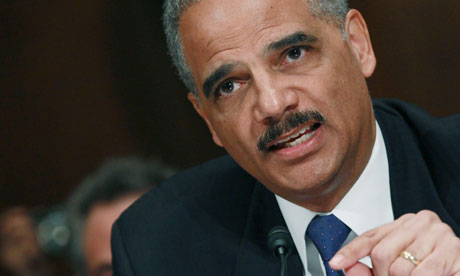
U.S. AG Eric Holder, credit: Infowars
Holder To Justify Killing Americans On Foreign Soil
Obama administration firms up support for state-sponsored assassination


Paul Joseph Watson
Infowars.com
Monday, March 5, 2012

 Attorney General Eric Holder will today attempt to justify the Obama administration’s policy of state-sponsored assassination, as he prepares to give a speech explaining how the U.S. government can arbitrarily kill U.S. citizens on foreign soil.

“Holder plans to say in a major speech on Monday at Northwestern University law school in Chicago that lethal force is legal under a Sept. 18, 2001, joint congressional resolution,” reports the Associated Press.

The notion that the White House can target Americans for summary execution by merely claiming that they are associated with terrorism is chilling given the fact that Americans who engage in political activism or even banal behaviors have been characterized as potential terrorists by U.S. authorities.

The White House has asserted the right to carry out state-sponsored assassination anywhere in the world without having to provide any evidence or go through any legal process. The administration merely has to state that the target is a terrorist and it doesn’t matter whether they are an American citizen or not, as we saw in the case of American-born Anwar al-Awlaki and his son, who were both killed last year.

In December, Obama administration lawyers reaffirmed their backing for state sponsored assassination, claiming that “U.S. citizens are legitimate military targets” and do not have the right to any legal protection against being marked for summary execution.

During a CBS 60 Minutes interview in January, Secretary of Defense Leon Panetta revealed that Obama himself personally approves the policy to kill American citizens suspected of terrorism without trial on a case by case basis.

“So it’s the requirement of the administration under the current legal understanding that the president has to make that declaration, not you?” Panetta was asked, to which he replied, “That is correct.”

The administration’s support for state-sponsored assassination without a shred of legal oversight puts into context the worthlessness of an Obama ‘policy directive’ last week that promised the White House would not indefinitely detain American citizens under the National Defense Authorization Act, which Obama signed on New Years Eve.

As we documented at the time, it was the administration itself which demanded the controversial detention without trial provisions of the NDAA be applied to American citizens.
The NDAA defines the entire planet, including America, as a “battlefield,” meaning Americans could also hypothetically be assassinated without any legal process on U.S. soil under the legal framework that has been codified under Obama.

The recent announcement that up to 30,000 drones will be in American skies within ten years, allied to the DHS plan to spend up to $50 million dollars on a spy system that has been used to hunt insurgents in Iraq and Afghanistan for the purposes of “emergency and non-emergency incidents” within the United States, makes it clear that Americans are being targeted as terrorists at both home and abroad.
*********************

Paul Joseph Watson is the editor and writer for Prison Planet.com. He is the author of Order Out Of Chaos. Watson is also a regular fill-in host for The Alex Jones Show and Infowars Nightly News.

Leaked Stratfor Emails: OBL not buried at sea...oh really?

Osama bin Laden
OBL, the media may have been misinformed, photo credit: U.S. Gov`t/
Business Insider
LEAKED STRATFOR EMAILS: Analysts Didn't Believe Bin Laden Was Buried At Sea
Business Insider
Michael Kelley
Mar. 1, 2012, 4:27 PM

Directors of the private U.S. security firm Stratfor did not believe that Osama bin Laden was buried at sea, according to Stratfor emails leaked by WikiLeaks.

At 5:26 a.m. on May 2, the morning after Barack Obama announced the successful raid on bin Laden's Abbottabad compound, Stratfor CEO George Friedman sent an email with the subject "[alpha] OBL" that said:

     Reportedly, we took the body with us. Thank goodness.

Fred Burton, Stratfor's vice president for intelligence, followed that up at 5:51 a.m. with an email titled "[alpha] Body bound for Dover, DE on CIA plane" that said:

     Than [sic] onward to the Armed Forces Institute of Pathology in Bethesda.

At 1:36 p.m. Burton replied to a thread named "Re: OBL's corpse" with the message:

     Body is Dover bound, should be here by now.

That contradicts the official story that bin Laden's body was handled in accordance with Islamic tradition and released into the sea from a U.S. Navy vessel.

Stratfor provides confidential intelligence services to large corporations and government agencies, including the U.S. Department of Homeland Security, the U.S. Marines and the U.S. Defense Intelligence Agency.

Friedman— author of numerous articles and books on national security, warfare and intelligence— founded the Austin, Texas-based company in 1996.

Burton is a former Deputy Chief of the Department of State's counterterrorism division for the Diplomatic Security Service (DSS). The DSS assists the Department of Defense in following leads and doing forensic analysis of hard drives seized by the U.S. Government in ongoing criminal investigations.

WikiLeaks has published 651 out of what they say is a cache of 5 million internal Stratfor emails dated between July 2004 and December 2011 obtained by the hacker collective Anonymous around Christmas.

Additional Readings:
STRATFOR: Osama Bin Laden 'Was In Routine Contact With Pakistan's Spy Agency' - Business Insider Feb 28, 2012

Saturday, March 3, 2012

The NTC`s form of Freedom, Democracy, Justice in Libya (Libya SOS)

MAR 2, 2012
Libya SOS.blogspot
View the NTC`s version of Freedom, Democracy, Justice currently in Libya where the whole media-establishment and world powers have forgotten since their 'job is done.'

View an archive of the NTC Rebel`s crimes by Libya SOS

Visit Libya SOS for all current news in Libya (only the honest truth & deception free)

So this is the FREEDOM, SOCIAL EQUALITY the global-powers and the NTC promised to the Libyans huh?

Libyan rebels cage black Africans in zoo, force feed them flags (SHOCKING VIDEO)
RT News
Published: 02 March, 2012, 13:54
Edited: 02 March, 2012, 17:56

Courtesy: YouTube user MLAktion

A shocking video has appeared on the Internet showing Libyan rebels torturing a group of black Africans. People with their hands bound are shown being locked in a zoo-like cage and allegedly forced to eat the old Libyan flag.

“Eat the flag, you dog. Patience you dog, patience. God is Great,” screams a voice off-camera in the video uploaded to YouTube last week, which also made its way onto LiveLeak.com.

The torturers are also shown making the group of captive black Africans stand up with pieces of green cloth still in their mouths and apparently forcing them start jumping.

A number of people are shown standing outside the cage watching the atrocity.

After Muammar Gaddafi was killed, hundreds of migrant workers from neighboring states were imprisoned by fighters allied to the new interim authorities.

They accuse the black Africans of having been mercenaries for the late ruler.

In the course of the fighting to topple Gaddafi last year, sub-Saharan African migrants and refugees “became targets of stigma, discrimination and violence,” the human rights group Amnesty International said last month.

“At the beginning of the crisis, there was vastly exaggerated propaganda for which the highest level of the National Transitional Council should take some responsibility because they largely contributed to that unfounded propaganda,” said Donatella Rovera, Amnesty’s senior crisis response advisor.

Some of the black migrants managed to flee into neighboring Mali and Niger, but more than 5,000 were detained. They face mass execution, beatings, and revenge killings, according to an Al Jazeera report published back in September.

Before the Libyan uprising broke out, the country hosted about a million black African workers, many of them employed in domestic work, construction, trash collection and other low-wage jobs.

Human Rights Investigations (HRI) suspect Libyan rebels of ethnic cleansing of the black population of the country, particularly in the city of Tawergha.


Additional Readings

Libyan Revolution Update: Enjoying “Freedom” NATO-backed rebels cage black Africans in zoo cages - Infowars March 4, 2012