Showing posts with label military. Show all posts

Thursday, March 6, 2014

What mainstream media isn`t telling about Ukraine, Russia and Crimea - learn the facts

Russia’s 25,000-troop allowance & other facts you may not know about Crimea
RT NEWS
March 04, 2014


People watch a Russian Navy ship enter the Crimean port city of Sevastopol March 2, 2014 (Reuters / Baz Ratner)
People watch Russian Navy ship enter Crimean port city of Sevastopol March 2, 2014 (Reuters/Baz Ratner)
Ukraine’s statement at the UN that ‘16,000 Russian soldiers had been deployed’ across Crimea sparked a MSM feeding frenzy that steadfastly ignored any hard facts that got in their way.

Especially unwelcome is the fact that the so-called ‘invasion force’ has been there for 15 years already.

The media many trust described in hysterical tones how the Autonomous Republic of Crimea was under a full-scale Russian invasion with headlines like: “Ukraine says Russia sent 16,000 troops to Crimea”, “Ukraine crisis deepens as Russia sends more troops into Crimea,” as well as “What can Obama do about Russia's invasion of Crimea?”.

Facts, and ardent statements by top Russian diplomats were totally ignored by the western ‘war press’.

Russian UN Ambassador Vitaly Churkin pointed to the longstanding 25,000 troop allowance while FM Sergey Lavrov stressed the Russian military “strictly executes the agreements which stipulate the Russian fleet’s presence in Ukraine, and follows the stance and claims coming from the legitimate authority in Ukraine and in this case the legitimate authority of the Autonomous Republic Crimea as well.”

So here they are, the facts:
1) A Russian naval presence in Crimea dates to 1783 when the port city of Sevastopol was founded by Russian Prince Grigory Potemkin. Crimea was part of Russia until Nikita Khruschev gave it to Ukraine in 1954.

2) In 1997, amid the wreckage of the USSR, Russia & Ukraine signed a Partition Treaty determining the fate of the military bases and vessels in Crimea. The deal sparked widespread officer ‘defections’ to Russia and was ratified by the Russian & Ukrainian parliaments in 1999. Russia received 81.7 percent of the fleet’s ships after paying the Ukrainian government US$526.5 million.

3) The deal allowed the Russian Black Sea Fleet to stay in Crimea until 2017. This was extended by another 25 years to 2042 with a 5-year extension option in 2010.

4) Moscow annually writes off $97.75 million of Kiev’s debt for the right to use Ukrainian waters and radio frequencies, and to compensate for the Black Sea Fleet’s environmental impact.

5) The Russian navy is allowed up to

- 25,000 troops,

- 24 artillery systems with a caliber smaller than 100 mm,

- 132 armored vehicles, and

- 22 military planes, on Crimean territory.

6) Five Russian naval units are stationed in the port city of Sevastopol, in compliance with the treaty:

- The 30th Surface Ship Division formed by the 11th Antisubmarine Ship Brigade. Comprises the Black Sea Fleet’s flagship guard missile cruiser Moskva as well as Kerch, Ochakov, Smetlivy, Ladny, and Pytlivy vessels, and the 197th Landing Ship Brigade, consisting of seven large amphibious vessels;

- The 41st Missile Boat Brigade includes the 166th Fast Attack Craft Division, consisting of Bora and Samum hovercrafts as well as small missile ships Mirazh and Shtil, and 295th missile Boat Division;

- The 247th Separate Submarine Division, consisting of two diesel submarines – B-871 Alrosa and B-380 Svyatoy Knyaz Georgy;

- The 68th Harbor Defense Ship Brigade formed by 4 vessels of the 400th Antisubmarine Ship Battalion and 418 Mine Hunting Ship Division respectively.;

- The 422nd Separate Hydrographic Ship Division boasts the Cheleken, Stvor, Donuzlav and GS-402 survey vessels and hydrographic boats.

7) Russia has two airbases in Crimea, in Kacha and Gvardeysky.

8) Russian coastal forces in Ukraine consist of the 1096th Separate Anti-Aircraft Missile Regiment in Sevastopol and the 810th Marine Brigade, which hosts around 2,000 marines.

9) Russian naval units are permitted to implement security measures at their permanent post as well as during re-deployments in cooperation with Ukrainian forces, in accordance with Russia’s armed forces procedures.

Authorities in the Ukrainian Autonomous Republic of Crimea – where over half the population is Russian – requested Moscow’s assistance after the self-proclaimed government in Kiev introduced a law abolishing the use of languages other than Ukrainian in official circumstances.

Last week, Russia’s Federation Council unanimously approved President Vladimir Putin’s request to send the country’s military forces to Ukraine to ensure peace and order in the region “until the socio-political situation in the country is stabilized.”

However, the final say about deploying troops lies with Putin, who hasn’t yet made such a decision, stressing that deploying military force would be a last resort.

Wednesday, July 18, 2012

Jubilation in N. Korea: Leader Kim Jong-Un named Marshal of nation`s military, country`s top military rank

Dancing on the street of Pyongyang... after soldiers learn Kim Jong Un has given himself top military job
  • Son of Kim Jong-Il is already leader of Korean People's Army
  • Scenes of jubilation from soldiers as son of former leader is revealed as head of military
By DAILY MAIL FOREIGN SERVICE
July 18, 2012

North Korean soldiers danced in the streets and shopping centres of Pyongyang yesterday after it was announced that leader Kim Jong Un was named as head of the reclusive nation’s military.

State media said in a special noon bulletin that North Korea’s military, government and political leadership had decided to award the top title to Kim, who already is supreme commander of the Korean People’s Army.

It solidifies his standing seven months into Kim’s rule and follows several days of reshuffling at the highest levels of the military.

Stand easy: North Korean soldiers from the Korean People's Army dance in Pyongyang following the Kim Jong Un announcement

Celebration time: Thousands of soldiers gathered following the announcement that Kim Jong Un would become the head of North Korea's military
[...]

The title of marshal - held previously by Kim’s father and grandfather, North Korea founder Kim Il Sung - is 'another brick in the wall of consolidating Kim Jong Un’s power, across party, state and military institutions,' said John Delury, a North Korea analyst at Yonsei University in South Korea.

Members of the military in North Korea had gathered to offer their new leader 'their highest glory and congratulations'
Members of the military in North Korea had gathered to offer their new leader 'their highest glory and congratulations.'
New regime: Kim Jong Un, pictured here with former military chief Ri Yong Ho in February, is now the leader of the Korean People's Army
New regime: Kim Jong Un, pictured here with former military chief Ri Yong Ho in February, was made supreme commander of the Korean People's Army in December following the death of his father
Choreographed: Kim Jong Un, who is already supreme commander of North Korea's army, is now the head of the nation's entire military
Soldiers and students in uniform filled the streets of the capital to celebrate, dancing and singing patriotic songs despite the rain.

'I am pleased that our cherished desire came into reality,' Kim Jong Gum, a student at the Kang Pan Sok Revolutionary School dressed in a military uniform, told The Associated Press. 'July 18th: This day will be remembered in our hearts as another meaningful and auspicious day.'

He was made supreme commander of the army in December, just days after his father’s death from a heart attack...

(Read the full article at DAILY MAIL)

Tuesday, April 10, 2012

Russian radar in Armenia to block an US/Israeli strike on Iran from the north (Debka File)

DEBKAfile Exclusive Analysis
April 8, 2012, 12:26 PM (GMT+02:00)

Russia's S-400 Triumf missiles posted in Kaliningrad, photo credit: Ria Novosti
Moscow has stepped into the vacuum created by US President Barack Obama’s decision to stay out of any potentially incendiary Middle East involvement while campaigning for a second term. After blocking the way to direct Western and Arab military intervention in Syria through the Mediterranean, Russia sent its Foreign Minister Sergey Lavrov last week on a round trip to the capitals of Armenia, Azerbaijan, Kazakhstan, Kyrgyzstan and Uzbekistan – an expedition designed to secure Iran against a potential US/Israeli attack via its northern and eastern neighbors, DEBKAfile’s military sources report.

On his return to Moscow, April 6, the Russian army let it be known that highly-advanced mobile S-400 surface-to-air missiles had been moved into Kaliningrad, the Baltic enclave bordered by Poland and Lithuania, its response to US plans for an anti-Iran missile shield system in Europe and the Middle East.

In Yerevan, the Russian minister finalized a deal for the establishment of an advanced Russian radar station in the Armenian mountains to counter the US radar set up at the Turkish Kurecik air base, our sources disclose.

Just as the Turkish station (notwithstanding Ankara’s denials) will trade data on incoming Iranian missiles with the US station in the Israeli Negev, the Russian station in Armenia will share input with Tehran.

Moscow remains deeply preoccupied in Syria, successfully fending off Western and Arab pressure against its ruler Bashar Assad. DEBKAfile’s sources hear that Assad will not meet the April 10 deadline for moving his heavy armor and battalions out of Syrian cities. Monday, April 8, he sent his foreign minister Walid Moallem to Moscow for instructions for getting him off the hook of failing to comply with his commitment to the UN envoy Kofi Annan’s peace plan, starting with a truce.

Lavrov, rather than US Secretary of State, Hillary Clinton is evidently regarded these days as the senior Middle East power broker. In a thumbs-down on Russia’s deepening footstep in the region, the London-based Saudi Sharq al Awsat captioned a Sunday op-ed item, “Nor do we want a ‘Sheikh’ Lavrov.”

For the first time since the Cold War ended, the management of a major world crisis has passed into the hands of the Kremlin in Moscow and the UN Secretariat in New York.
Weeping crocodile tears, UN Secretary General Ban Ki-moon said Saturday that the April 10 date for a Syrian truce “was not an excuse for continued killing” by the Syrian regime, ignoring the fact that “the continued killing” could have been avoided were it not for the strategy pursued by Kofi Annan, the special envoy he shares with the Arab League, with Moscow’s back-stage wire-pulling.

This is because President Barak Obama is advised by his campaign strategists that the way to the American voter’s heart in November is through burnishing his image as a “balanced and responsible” multinational diplomat, in contrast with his Republican rivals’ hawkish support of an Israeli attack on Iran’s nuclear program.

In the case of Syria, the White House finds itself on the same side as the UN and the Kremlin. They all share the common goal of obstructing Western and Arab military intervention in Syria at all costs.

Hundreds of Syrian protesters are still paying the price in blood - although its dimensions of the butchery are frequently exaggerate by the opposition. After brutalizing his population for thirteen months, Bashar Assad is more or less on top of the revolt in Syria’s main cities, excepting the Idlib province and one or two pockets in and around Homs. He used the extra days afforded him by Kofi Annan’s deadline for the ruthless purge of the last remnants of resistance in small towns and villages, cetain that Moscow, the UN secretary - and Washington, by default - would do nothing to stop him.

Should current circumstances shoot off in unforeseen directions – for instance, a Syrian government poison chemical or biological weapon attack causing hundreds of dead, over and above the 9,000 confirmed by UN figures – Obama might be forced to resort to limited military action, pulling in the Turkish army. This has not yet happened.

That the Russians are not letting the grass grow under their feet, turning Middle East bushfires to their advantage and closing one American Middle East option after another, appears to be a minor consideration in Washington up until November.

Friday, April 6, 2012

Active-duty Marines detained with military explosives in LA - botched false-flag op?

Marines detained with military explosives described as 'remorseful'
LA Times
April 6, 2012 | 12:52 pm

Two Marines taken into custody in Redondo Beach in connection with explosive devices found in the back of their pickup truck were described by a local police captain as “remorseful.”

“They were shocked at the attention they had received,” said Capt. Jeff Hink, who arrived on scene at the South Bay Galleria at 10:45 p.m. Thursday. “They were young guys. They shouldn’t have had those devices and didn’t realize the gravity of the situation until they were knee-deep in it.”

Lance Cpl. Devin Gajewski, 24, and Pvt. Thomas Bazer, 20, were not in custody but have returned to Marine Corps Air Ground Combat Center Twentynine Palms, according to public affairs office Capt. Nick Mannweiler.

Mannweiler identified Gajewski as a tank crewman with the First Tank Battalion, First Marine Division, and Bazer as a field radio operator in the same unit. Details regarding a hearing and possible charges have not been released.

The two active-duty Marines were initially taken into custody by Redondo Beach police officers just after 8 p.m. Thursday before being released to investigators with the Naval Criminal Investigative Services.

According to Hink, Gajewski and Bazer were contacted by an officer from the Twentynine Palms military base and told to stay where they were in the vicinity of the Galleria and to cooperate with law enforcement.
The Marine Corps then contacted the Redondo Beach police department, who found the soldiers beside their vehicle in the Living Spaces parking lot. Police approached the situation with caution.

“We knew they were explosives, and they should not have been in their possession and could be dangerous if improperly used,” said Hink.

The Los Angeles County sheriff's bomb squad was called to the scene and employed a robot to investigate the devices. Ten explosive devices, commonly referred to as artillery simulators, were found inside the truck, police said.

Mannweiler described the devices as capable of producing a bright flash and a loud bang and are used to simulate mortar or artillery strikes. They do not produce shrapnel and are considered nonlethal.

According to Living Spaces assistant sales manager David Dominguez, 45, the store was busy when a dozen employees and nearly 30 customers were told to evacuate. Some customers, said Dominguez, were told to return to the store at another time to complete their purchases.

Customers were escorted out a side entrance, where they had to make arrangements to be picked up if their cars were in the vicinity of the Marine’s vehicle. Some cars were still in the parking lot Friday morning when Dominguez arrived for work.

Eventually, Redondo Beach police evacuated the Target with nearly 200 customers and the Nordstrom Rack with 50 to 100 customers.
The scene was eventually cleared by Redondo Beach police about 12:30 a.m.


Related:
More Furious: U.S. Soldiers Trafficking Arms, Drugs to DEA Agents Posing as Los Zetas

Monday, February 27, 2012

Russia upgrades its 'eyes & ears' in Middle East

Russia upgrades Syria-based electronic station to warn Iran of US/Israeli attack
DEBKAfile Special Report 
February 27, 2012, 11:09 AM (GMT+02:00)


Russian electronic station on Jabal al Harrah, image credit: Debkafile
The Russians have upgraded their Jabal Al Harrah electronic and surveillance station south of Damascus opposite Israel’s Sea of Galilee, adding resources especially tailored to give Tehran early warning of an oncoming US or Israeli attack, DEBKAfile’s US military sources report.

Before it was boosted by extra advanced technology and manpower, the station covered civilian and military movements in northern Israel up to Tel Aviv, northern Jordan and western Iraq. Today, its range extends to all parts of Israel and Jordan, the Gulf of Aqaba and northern Saudi Arabia.

Part two of Moscow’s project for extending the range of its Middle East ears and eyes consisted of upgrading the Russian-equipped Syrian radar stationed on Lebanon’s Mount Sannine and connecting it to the Jabal Al Harrah facility in Syria. Russian technicians have completed this project too. Russia is now able to additionally track US and Israeli naval and aerial movements in the Eastern Mediterranean up to and including Cyprus and Greece.


According to our sources, the Russian aircraft carrier Admiral Kutznetsov’s stay at the Syrian port of Tartus through most of January and up to mid-February had the special mission of keeping an eye out for any Israeli preparations for attacking Iran, Syria or Hizballah. It filled the gap left by the Russian station south of Damascus which was fully occupied with feeding data on Syrian opposition movements to Bashar Assad and watching out for signs of foreign intervention, military or covert, against his regime.

The Russian vessel meanwhile followed increased traffic of US drone over Syria keeping track of the Syrian arsenal of missiles with chemical, biological and nerve gas warheads.
Washington disclosed on Feb. 25 that the US State Department had sent out warnings to six countries, Israel, Turkey, Lebanon, Saudi Arabia, Jordan and Iraq, to beware of these deadly weapons. It was not clear whether the warning referred to a possible Assad regime’s decision to use WMD against those nations or the danger of their transfer to terrorists embedded within those countries.

Moscow decided to boost its radar tracking and surveillance reach for Iran’s benefit in response to a complaint from Tehran that it could not longer count on Russia for a real-time alert on an incoming US or Israeli military strike, because those resources were stretched to the limit in support of the Assad regime.

After expanding and upgrading their range to meet Iranian needs by interconnecting the two stations and adding extra Russian manpower, Moscow ordered the Admiral Kutznetsov to depart Tartus on Feb. 13 and sail to home port at Severomorsk on the Kola Peninsula. The Russian stations in Syria and Lebanon were by then ready for their expanded missions.

Tuesday, January 24, 2012

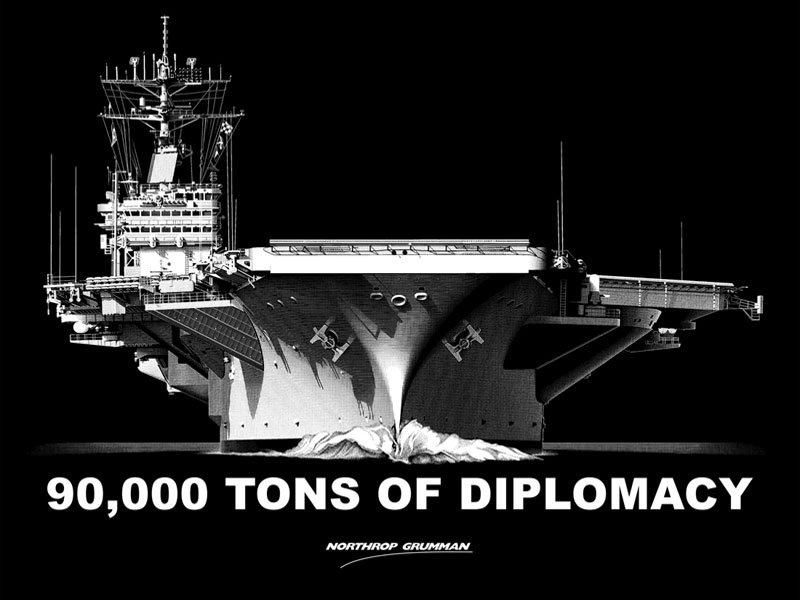
American democracy & diplomacy...take your pick

image: freedom-pictures


The George H. W. Bush (CVN 77) the nation’s 10th and final Nimitz-class aircraft carrier, Northrop Grumman poster. (Image: Education-for-Solidarity)

Tuesday, March 16, 2010

India Beefing up its Military

What`s behind the sudden surge in India`s defense spending

India`s been making headlines recently as it openly signed deals and contracts to procure significant military hardware, namely for its navy and airforce. The deals announced between, now the primary arms supplier Russia and India are staggering and the pacts have been valued at more than $10 billion which on top of previous deals still on the books. The high profile deals were officially signed during Prime Minister Vladmir Putin`s visit to India on March 12, 2010. Military hardware aside, the recent pacts additionally call for more increased cooperation and partnership in areas of developing nuclear reactors, equipment for GPS systems and airplane and truck assembly plants.

Russia additionally wants to increase annual trade with India from the current level of about $8 billion to $20 billion by 2015. Russia now currently supplies 60-70% of India`s defense equipment. On the nuclear side, Russian deputy Prime Minister Sergei Ivanov said Russia will build up to 16 nuclear reactors for power stations in India. Russia nuclear reactors have been cited as one of the best and safest in the world.

Over the next 12 years, India is set to spend a whopping $200 billion on defence acquisitions to replace its outdated inventory. In this regard, on February 15, 2010, a report of the Indian strategic defense magazine (India Strategic’s DefExpo) revealed that 70% of the inventory of the Indian armed forces is 20-plus years old, and needs to be replaced with modern technology. It explained that nearly half of this funding ($100b) will go to the Indian Air Force (IAF), which would need to replace more than half of its combat jet fleet as well as the entire transport aircraft and helicopter fleet. The army needs new guns, tanks, rocket launchers, multi-terrain vehicles, while the navy needs ships, aircraft carriers and new range of nuclear submarines.

During a recent visit of the US Secretary of Defense Robert Gates to New Delhi, American Defence officials, however, have said that US weapons sales to India would not be a focus of the trip. Regardless of such denials, the key reason for the Gates’ visit can be found in the fact that India is planning to raise its military budget by 50% to almost $40 billion, making military expenditure 3% of the annual GDP. In contrast to India’s planned defence expenditures, Pakistan’s entire 2009-10 budget amounts to little over $30 billion!

The fact of the matter is, India wants to become a mini-superpower of the region and hence it uses the pretext of deterrence against Pakistan and China. In this context, New Delhi with the dual support of the US and Israel has presumed peace-loving Pakistan and China as their arch enemies, but it does not admit it officially.

Recent major military acquisitions:
-Signed $1.5 bln contract on 29 additional MiG-29K Fulcrum carrier based fighter jets (this is in addition to a contract for 12 single-seat MiG-29k and 4 double-seat MiG-29KUB to India navy)

-Deal to upgrade the Admiral Gorshkov aircraft carrier at a cost of $2.3 bln. (The Gorshkov is a Kiev-class carrier, displaces 45,000 tons, 32 knots and endurance of 13,500 nautical mi. The carrier will be rechristened the Vikramaditya)

- Deal to deliver 42 Su-30MKI jet fighters to Indian airforce, at a cost of $3 bln (This is in addition to 69 jets previously ordered by India and set to be delivered in 2011. The new air-superiority fighters will come on top of the 230 already contracted from Russia in three deals worth a total of $8.5 billion.)

-Joint venture to produce GPS equipment, the Glonass, for the use of defense needs (Glonass- the Global Navigation Satellite System is the Russian equivalent to the US Global Positioning System or GPS.


Tuesday, December 8, 2009

India, Slowly Becoming a South-East Asian Superpower

The Hindustani nation of India slowly flexing it`s muscles in South-East asia
The nation of India is making headlines on the international front that slowly is making the hindustani nation become a superpower in the south-east asian region. This week, ahead of scheduled meetings between the heads of state, India and Russia signed deals on nuclear energy and arms sales.

Russia is already building two nuclear power units in the southern Indian state of Tamil Nadu and agreed to install four more nuclear reactors there as part of an agreement signed during Medvedev's visit to India last year. The Russia's state-owned nuclear power firm - Rosatom could build up to 20 nuclear power units in India in all, including four to six in the state of West Bengal, the ITAR-TASS state news agency reported, citing the company's chief.
"These are not just billions, these are tens of billions of dollars" worth of contracts, Rosatom chief Sergei Kiriyenko said, quoted by ITAR-TASS. On the arms side, India is looking for better air-defense capabilities, bolstering it`s navy as well as their airforce. It has been known for some time, India has been looking into AWACS for their airforce and other electronic warfare equipment as well as upgrading their soviet-era air fleet. India also soon will have an additional member to it`s navy fleet, the retired soviet-era 44,570-ton aircraft carrier Admiral Gorshkov.

All this comes on the heels of a joint venture between India and Russia to develop multirole transport aircraft (MTA). The plan calls for the production of 21o MTA`s jointly, with Russia buying 100 and India buying the rest. The MTA is intended to replace the Indian Air Force's transport aircraft, most of which were bought from Russia. India has about 100 medium-lift An-32s and about 20 heavy-lift Il-76s. In 2008, India signed a contract for the purchase of six C-130 Hercules transport planes from the U.S.

With all this said, India slowly is becoming a major superpower in the region but nothing close to China`s level yet but, India does have a faster rate of growth. If you look at Indian state ideals for the past 50-60 years, they have overcome so much to be where they are all in spite of their bitter neighboring rival Pakistan over nuclear capabilities. Now, it seems India wants to have an upper hand in the region to counter any possible Pakistani aggression should the government be dissolved and left to the radical mullahs or any other potential action to destabilize the region.

Monday, December 7, 2009

Holes in Iranian Air Defense?


Flaws found in recent Iranian air defense exercise

Iran`s recent air and missile-defense exercise has revealed flaws in its capabilities to effectively defend high value sites - namely its nuclear installations from attack. This is according to international experts who have spoken to janes.

The 3-part exercise was conducted in late November to showcase Iran`s ability to make it "impossible for enemy jets to enter Iranian territory," by Brig. Gen. Ahmad Mighani, commander of the air force and of the exercise. Of all the positive spin about the exercise, it hid the shortcomings of Iran`s ground-based air-defense systems, that were apparently seen in photos released by the state media during and after the exercise.

The photos released indicated the age and the technical deficiencies of the air-defense systems in the exercise. Aside from the Russian-made Tor-M1 (SA-15) surface-to-air missile systems, the entire cache of Iranian air-defense equipment would no match for current air fleets and electronic warfare systems used by USAF or IAF, according to analysts.

This should be a wake up call for Iran to bolster it`s air-defense capabilities against it`s nuclear installations. USAF or IAF air fleets have the capability to quickly deal a devastating strike on Iranian high-value targets without significant casualties. Although Russian-Tor-M1 missiles surely pose a direct threat to air fleets, they but can`t cover all the territory than encompasses Iranian high-value targets. It is known Iran signed a deal worth $1 billion covering the procurement of up to 29 Tor-M1 missile systems.

However, Iranian military commanders in closed-door sessions may have taken wind of their air-defense results and secretly contemplating the next step. They may be discussing options of procuring sophisticated air-defense batteries as well as additional Tor-M1 missiles systems from Russia. It is known though, through Sergei Ivanov, the Russian defense minister, that Moscow will continue to develop military and technical cooperation with Tehran. This could hint on further sales of S-300 (SA-12) air-defense missiles, which were requested by Iran for several years, but so-far denied by Russia.

What ever the result, Russia has a vested interest in Iran and will see it through that Iran survives any conflict while trying to reduce a U.S. hegemony in the region

Venezuela Arming Itself

It seems Hugo Chavez, president of Venezuela, is readying itself for a possible confrontation with neighboring Colombia - considered a proxy for the U.S. This is all comes on the heels of recent news that the U.S. will continue to have access to Colombian military bases that are around the capital of Bogota and the border with Venezuela as well as increasing troop levels at the bases. The seven bases the U.S. military will operate from is termed for the use in controlling the drug trade and insurgents in Colombia and around the region.

Chavez claims his country will be attacked, a charge both the U.S. and Colombia denies, and is strengthening his country to counter any possible military conflict. "They are preparing a war against us," Chavez said during a televised address, repeating a charge he has been making for months. "Preparing is one of the best ways to neutralize it."

Russia of course is the main supplier of arms to Venezuela, recently opening a $2.2 billion line of credit for the purpose to sell more weapons. Russian arms sales since 2005 to Venezuela has been more than $4 billion, including 24 Sukhoi fighters, attack helicopters and about 100,000 kalashnikov rifles.

Chavez`s claim on Monday that Russian T-72 main battle tanks will be arriving soon will surely complicate the situation even further to possible U.S./Colombian intervention. His additional claim that thousands of missiles will also be arriving was unspecified of the type but Venezuela does have a growing arsenal of Russian-made Igla-1S surface-to-air missiles. There`s no doubt Venezuela will soon acquire these arms even if not more from Russia. Both Colombian and US forces should take notice and closely monitor the situation, treading lightly into any "possible" operation into Venezuela.

As we all know by now, US special forces are around and operate in the region - something that will always be denied. Venezuela too wouldn`t escalate into a full scale operation unless it felt directly or imminently threatened but would deal a nasty blow to any incursions made by "forces" on its soil.