Showing posts with label Russia. Show all posts

Tuesday, April 29, 2014

With recent tensions between Ukraine-Russia highlighting pivotal oil and gas supply, a similar issue can brew between Bangladesh and India

The India-Bangladesh Power Trap
A reliance on India for its electricity could be contrary to Bangladesh’s geo-strategic interests.

By Zahedul Amin
The Diplomat
April 27, 2014

Following the election of its Awami League (AL) government in 2009, Bangladesh’s diplomatic relations with India have enjoyed some renewed vigor. In the years since, the relationship has flourished, with a series of high-level meetings culminating in a visit from Indian Prime Minister Manmohan Singh in 2011 to sign a joint communiqué. The communiqué focused on three key aspects: peacefully resolving a long-standing border dispute, ensuring a fair allocation of Teesta river water, and allowing transit to India through Bangladesh.

Although the Bangladesh government is already offering transit facilities on a selective basis (without charging a transit fee), India has yet to deliver on its promises. The border dispute remains unresolved in the face of stiff resistance from the opposition Bharatiya Janata Party (BJP), while the Teesta water sharing agreement has stalled, thanks to the belligerence of West Bengal Chief Minister Mamata Banerjee. A promised $1 billion credit line from India has been caught up in bureaucratic red tape. As a consolation, India has at least agreed to export 500 MW of power to Bangladesh at a competitive rate.

For its part, Bangladesh has now decided to provide a corridor for Indian power transmission, from Assam to Bihar. In return, India has promised to increase power exports to 1500 MW in the near future, which would partially assuage Bangladesh’s persistent power shortages. However, could an overt dependence on Indian electricity spell danger for Bangladesh’s strategic interests?

To answer that question, it is important to understand Bangladesh’s power sector. Power shortages remain a chronic problem for Bangladesh, mainly because of a lack of effective investment and dwindling reserves of natural gas. Currently, peak power demand for Bangladesh stands at 8,349 MW, against installed generation capacity of 10,289 MW, although only about 75 percent of that capacity is operational, leaving a substantial shortfall. In fact, the demand-supply gap was higher in 2008, which the government addressed by turning to “quick rental” power stations owned by the private sector. As of 2013, the government had arrangements with 20 of these stations, which combined generated power in excess of 1,000 MW. These stations, however, are run on diesel or heavy fuel oil, making them costlier compared to more traditional energy sources, meaning that end consumers need to be heavily subsidized by the government. Imports from India are much cheaper, at less than half the per-unit cost. Given these immediate cost advantages, the government of Bangladesh is keen to import more power from India.

However, while that might make economic sense, the question is whether Bangladesh can afford to increase its dependence on Indian power. Electricity is a key resource and the country’s manufacturing sector is entirely dependent on a seamless supply.

National elections are underway in India. A change in government looks likely, with BJP candidate Narendra Modi tipped to be the next prime minister. A new BJP government may well adopt a more hardline foreign policy stance.

A comparison can be made with the Russia-Ukraine crisis, in which Russia retains a powerful bargaining chip in the form of its shipments of natural gas. Since the falling out between the neighbors, Moscow has (through state-owned Gazprom) raised the gas price with more stringent payment terms. Russia has even threatened to cut off the natural gas supply entirely, something that would be catastrophic for the struggling Ukrainian economy.

A Bangladesh that is heavily dependent on Indian electricity could conceivably face a similar scenario in the future. In any disagreement, India could use its power card to keep Bangladesh in line. As a much smaller country, Bangladesh is already at a disadvantage in negotiating with India, a position that may be exacerbated with greater dependence on Indian power.

In the wake of these analyses, Bangladesh should think of alternative methods of generating electricity, reducing its dependence on both privately owned quick rental stations or Indian power. A long-term plan is needed to increase supply in step with rising demand. Bangladesh has adequate coal resources, which can be cheaply extracted. New power plants should be coal based, reducing pressure on natural gas reserves and expensive imported oil. Bangladesh should also construct an LNG terminal to facilitate natural gas imports.

Although India-Bangladesh relations are at an all-time high, Dhaka has mostly failed to extract anything tangible from the Indian side. India’s Border Security Force (BSF) is still regularly shooting Bangladeshi nationals, while Bangladeshi exports to India face a multitude of non-tariff barriers. With the shifting political landscape in India, the situation could be set to worsen, as the BJP has historically shown a more hardline stance towards its neighbors. In this context, Bangladesh should avoid an excessive reliance on its neighbor for electricity.

Zahedul Amin is the Co-founder and Director Finance & Strategy at LightCastle Partners, a business planning and intelligence firm specializing in emerging markets.

Thursday, March 6, 2014

Current hostilities in Ukraine & the region summarized in one image

image: rense.com

Questions on Ukraine the West chooses not to answer

by: RT NEWS
March 05, 2014 19:

Ukrainian and Western refusal to answer Moscow’s hard questions explains Russia’s tough stance on the crisis in Kiev.

Ignoring Russian concerns is a Western habit adopted after the Soviet Union’s collapse; when NATO bombed Yugoslavia; during the recognition of Kosovo as an independent state, and the US push to install an anti-missile shield over Europe that can target Russia.

It also happened recently when Western diplomats flocked to Ukraine to smile and wave and lobby their interests in a future Ukrainian government, while accusing Russia of meddling in Ukrainian affairs.

But it seems that in Ukraine lies Russia’s red line and Moscow no longer takes “don’t know, don’t care” for an answer.

Here’s the questions.

1. Why did the opposition oust Yanukovich after he conceded to their demands?
On February 21, Yanukovich and the three Ukrainian parliamentary faction leaders signed a reconciliation deal co-signed by Foreign Ministers of France, Germany and Poland. A gesture that their countries would serve as agreement guarantors.

The agreement provides a de-escalation roadmap of constitutional reform, a national unity government, early presidential election and disbandment of Maidan fighter groups.

Hours after it was signed, Right Sector radicals, key to the violence unleashed in Kiev which left a hundred people dead, gave Yanukovich an ultimatum: resign or face a siege of his residence.

Against Moscow’s advice, Yanukovich fled.

Vladimir Putin’s comments illuminate the Russian position here: "He [Yanukovich] had in fact given up his power already, and as I believe, as I told him, he had no chance of being re-elected.. What was the purpose of all those illegal, unconstitutional actions, why did they have to create this chaos in the country? Armed and masked militants are still roaming the streets of Kiev. This is a question to which there is no answer."

Russian President Vladimir Putin (AFP Photo)
Russian president Vladimir Putin (AFP photo)
Russia says the February 21 agreement must be implemented. The opposition signed it yet allows an uncontrolled militia of violent armed radicals send fear and loathing across a large swath of Ukraine.

The US says the agreement no longer matters – because Yanukovich fled. The EU signatories don’t seem to be bothered about it either.

2. Why is the coup-appointed govt replacing oligarchs linked to Yanukovich with... oligarchs?
Popular resentment of Yanukovich blossomed over corruption. Protesters pointed to power abuse, theft and allowing linked-oligarchs raid businesses of other clans. Evidence came readily after they fled - photos of their homes’ sumptuous interiors.

But the new self-appointed govt is replacing Yanukovich’s oligarchs with their own. Kiev just appointed billionaires as governors of Donetsk and Dnepropetrovsk respectively, a move that also drew Putin’s ire: "Mr. Kolomoisky was appointed governor of Dnepropetrovsk. This is a unique crook. He even managed to cheat our oligarch Roman Abramovich two or three years ago. Scammed him.."

Both hold major assets in their respective regions and thousands depend on them for work. Both appointments are meant to stabilize a volatile society and ensure loyalty to the capital but critics say Kiev is reinventing fiefdoms to nobility in exchange for servitude. For Putin, who famously excluded oligarchs from politics, the move is an anathema.

3. Why did the post-coup parliament strip Russian language of its regional status?
A bill repealing a law on regional languages was among dozens rubber-stamped by a chaotic Ukrainian parliament in the first post-coup days. It allowed the Ukrainian nationalist and anti-Russian Svoboda (Freedom) Party put a feather in its cap. Yet it sent a ripple of hostility south and east from Kiev, where Russian-speakers are a large minority or even majority. Kiev pledged to restore the status of Russian but now says the acting Ukrainian president won’t sign such a bill into law.

4. Why did Kiev attack the Constitutional Court?
Several Constitutional Court judges were accused of violating their oath and abruptly fired amid coup govt orders they be prosecuted. The judges branded this as an attack on the principle of separation of powers. Putin called it "monkey business".

As Yanukovich was not procedurally impeached but through a simple show of hands the legality of his impeachment is open to challenges taken by several Ukrainian regions and, diplomatically, by Russia. The Ukrainian Constitutional Court is the proper authority to rule on the issue yet the new Kiev admin is mooting totally disbanding it and giving its functions to the Supreme Court.

5. Why would the West support the coup in Ukraine?
From the Russian perspective, the West fueled the fires of protest and ensured the Ukrainian government was toppled. Now it is attempting to legitimize its factious replacement. What Russia calls an unconstitutional coup, the West is branding a public revolution. It is possible that it is both.

Moscow does not challenge the reality. It doesn’t seek a Yanukovich return to power. It would work with the people who ousted him, as it did with the Yushchenko presidency. But Moscow demands the Kiev coup govt carries a national mandate to govern, in both east and west . Without it, any government is unsustainable.

Putin’s position is that it now maybe too late, despite his repeated warnings Ukraine would polarize. "Did our partners in the West and those who call themselves the government in Kiev now not foresee that events would take this turn? I said to them over and over: Why are you whipping the country into a frenzy like this?"

A stable Ukraine is essential for Russia for many reasons, humanitarian being just few of them. Of course Russia wants ethnic Russians in Ukraine to be safe from potential violence and persecution. But there are also more pragmatic considerations as well.

There’s the Black Sea Fleet, strong economic interdependence and there is gas. Ukraine transits Russian natural gas to Europe and is thus essential to the Russian and European economies. Yet now a desperate Kiev mulls privatizing its gas pipelines to fill its empty coffers, while Moscow’s questions remain unheard.

What mainstream media isn`t telling about Ukraine, Russia and Crimea - learn the facts

Russia’s 25,000-troop allowance & other facts you may not know about Crimea
RT NEWS
March 04, 2014


People watch a Russian Navy ship enter the Crimean port city of Sevastopol March 2, 2014 (Reuters / Baz Ratner)
People watch Russian Navy ship enter Crimean port city of Sevastopol March 2, 2014 (Reuters/Baz Ratner)
Ukraine’s statement at the UN that ‘16,000 Russian soldiers had been deployed’ across Crimea sparked a MSM feeding frenzy that steadfastly ignored any hard facts that got in their way.

Especially unwelcome is the fact that the so-called ‘invasion force’ has been there for 15 years already.

The media many trust described in hysterical tones how the Autonomous Republic of Crimea was under a full-scale Russian invasion with headlines like: “Ukraine says Russia sent 16,000 troops to Crimea”, “Ukraine crisis deepens as Russia sends more troops into Crimea,” as well as “What can Obama do about Russia's invasion of Crimea?”.

Facts, and ardent statements by top Russian diplomats were totally ignored by the western ‘war press’.

Russian UN Ambassador Vitaly Churkin pointed to the longstanding 25,000 troop allowance while FM Sergey Lavrov stressed the Russian military “strictly executes the agreements which stipulate the Russian fleet’s presence in Ukraine, and follows the stance and claims coming from the legitimate authority in Ukraine and in this case the legitimate authority of the Autonomous Republic Crimea as well.”

So here they are, the facts:
1) A Russian naval presence in Crimea dates to 1783 when the port city of Sevastopol was founded by Russian Prince Grigory Potemkin. Crimea was part of Russia until Nikita Khruschev gave it to Ukraine in 1954.

2) In 1997, amid the wreckage of the USSR, Russia & Ukraine signed a Partition Treaty determining the fate of the military bases and vessels in Crimea. The deal sparked widespread officer ‘defections’ to Russia and was ratified by the Russian & Ukrainian parliaments in 1999. Russia received 81.7 percent of the fleet’s ships after paying the Ukrainian government US$526.5 million.

3) The deal allowed the Russian Black Sea Fleet to stay in Crimea until 2017. This was extended by another 25 years to 2042 with a 5-year extension option in 2010.

4) Moscow annually writes off $97.75 million of Kiev’s debt for the right to use Ukrainian waters and radio frequencies, and to compensate for the Black Sea Fleet’s environmental impact.

5) The Russian navy is allowed up to

- 25,000 troops,

- 24 artillery systems with a caliber smaller than 100 mm,

- 132 armored vehicles, and

- 22 military planes, on Crimean territory.

6) Five Russian naval units are stationed in the port city of Sevastopol, in compliance with the treaty:

- The 30th Surface Ship Division formed by the 11th Antisubmarine Ship Brigade. Comprises the Black Sea Fleet’s flagship guard missile cruiser Moskva as well as Kerch, Ochakov, Smetlivy, Ladny, and Pytlivy vessels, and the 197th Landing Ship Brigade, consisting of seven large amphibious vessels;

- The 41st Missile Boat Brigade includes the 166th Fast Attack Craft Division, consisting of Bora and Samum hovercrafts as well as small missile ships Mirazh and Shtil, and 295th missile Boat Division;

- The 247th Separate Submarine Division, consisting of two diesel submarines – B-871 Alrosa and B-380 Svyatoy Knyaz Georgy;

- The 68th Harbor Defense Ship Brigade formed by 4 vessels of the 400th Antisubmarine Ship Battalion and 418 Mine Hunting Ship Division respectively.;

- The 422nd Separate Hydrographic Ship Division boasts the Cheleken, Stvor, Donuzlav and GS-402 survey vessels and hydrographic boats.

7) Russia has two airbases in Crimea, in Kacha and Gvardeysky.

8) Russian coastal forces in Ukraine consist of the 1096th Separate Anti-Aircraft Missile Regiment in Sevastopol and the 810th Marine Brigade, which hosts around 2,000 marines.

9) Russian naval units are permitted to implement security measures at their permanent post as well as during re-deployments in cooperation with Ukrainian forces, in accordance with Russia’s armed forces procedures.

Authorities in the Ukrainian Autonomous Republic of Crimea – where over half the population is Russian – requested Moscow’s assistance after the self-proclaimed government in Kiev introduced a law abolishing the use of languages other than Ukrainian in official circumstances.

Last week, Russia’s Federation Council unanimously approved President Vladimir Putin’s request to send the country’s military forces to Ukraine to ensure peace and order in the region “until the socio-political situation in the country is stabilized.”

However, the final say about deploying troops lies with Putin, who hasn’t yet made such a decision, stressing that deploying military force would be a last resort.

Tuesday, September 10, 2013

Déjà vu again in Syria? Flashback to Gaddafi and Saddam who gave up weapons before being attacked and toppled

Is Assad Being Tricked Into Sacrificing Syria?
Or is the plan to relinquish chemical weapons a geopolitical master stroke?

Paul Joseph Watson
Infowars.com
September 10, 2013

Is President Bashar Al-Assad being tricked into creating circumstances that will hand the Obama White House a justification for war, or is the plan for Syria’s chemical weapons to be destroyed a geopolitical master stroke that will avert a regional conflict?

Syria’s Foreign Minister Walid Muallem today formally accepted a Russian proposal – first mooted by John Kerry – for Syria to hand its chemical arsenal over to international control in a bid to avoid a US military attack.

Many see the development as a stunning example of Russia once again outmaneuvering the United States, seizing on an apparent gaffe by Kerry in order to pull the rug out from underneath Washington and derail Obama’s pretext for war.

However, could the precondition of Syria destroying its chemical weapons actually be used to rescue a congressional vote that had looked doomed to fail?

[...]

In December 2003, Colonel Gaddafi agreed to give up his weapons of mass destruction and allow unimpeded inspections. This didn’t stop the Obama administration coming to the aid of Al-Qaeda-linked rebels eight years later to destroy Libya and leave it in the hands of brutal warlords.

Similarly, Saddam Hussein agreed to give UN weapons inspectors unfettered access in a desperate bid to prevent the US invasion of Iraq, but the move was completely futile because, as in the case of Syria, the decision to attack had already been made...

[Click here to read the full article]


Related info:
--Intercepts caught Assad rejecting requests to use chemical weapons, German paper says
--US Prepares 60,000 Ground Troops For Post-Assad Syria

Sunday, June 23, 2013

Russia`s answer to countering asteroid threat to the Earth

A Russian scientist has proposed using ICBM`s to fight threats posed by asteroids hitting Earth

This week its been reported that a Russian rocket scientist thinks a Russian ICBM can be used to destroy asteroids that pose a threat to the Earth, specifically the Soviet-era Voyevoda ICBM or NATO classification SS-18 Satan missiles. This news comes four months after a powerful meteor struck Russia’s Urals region, injuring 1,200 people in the area.

Now, the Soviet-era Voyevoda (SS-18 Satan) ICBMs which have been in service since 1967 "...are well-suited for fighting suddenly discovered small [space] objects,” said Sabit Saitgarayev, a senior researcher at the State Rocket Design Center in the city of Miass in the Chelyabinsk Region.

These ICBM`s use the standard liquid fuel based on hydrazine and not the cryogenic fuel used in Russian heavy space rockets like the Soyuz which cannot be kept for long and is supplied directly before the launch. In essence, the latter rocket fuel type requires several days for prepping the rockets for launch and would not be favorable against targets discovered only hours before hitting the Earth.

For this reason, the scientist says the Voyevoda missiles are favorable as they can take off 10-20 minutes after an order is given for launch and are able to "destroy small space objects with a diameter of up to 100 meters if the missile is equipped with the third stage and if reequipped with a booster, the missile will be able to destroy space objects five-six hours before their collision with the Earth", he said.

Currently, the Voyevoda (SS-18 Satan) are 2 staged ICBM`s with a payload capacity of 8.8 tons, that can carry up to 10 warheads, each with a yield up to 750 kilotons (TNT). "The [missiles] can stay in the condition of their readiness for launch for ten and more years, after some reequipping,” the scientist said.

Now, the only other question is, how the vicinity of the asteroid blast with the missiles along with the blast fragments will pose a grave threat to our ever growing number of satellites that orbit the planet as well as the ISS crew in space. This is of concern since when in 2007 China tested a ground-launched anti-satellite weapon and was condemned for it due to the dangers of the thousands of pieces of debris in orbit that continue to threaten both manned and unmanned spacecraft. 

Source:  Russian Scientist Proposes Satan Missiles to Fight Asteroid Threats (Ria Novosti)

Sunday, June 2, 2013

The emergence of the Soviet Union into the 21st century

The words 'Soviet Union' here in America conjures up feelings of Stalinist pride, Lenin, the cold war, Red commies, over opulent Russian oligarchs and the KGB but...in fact no one ever thinks of the accomplishments made by USSR during the Soviet Era.  - A personal favorite of mine is in terms of space exploration. We all know, if it wasn`t for the successes of Soviet Union in space, America and specifically NASA would have never got the foot off the ground. The once mighty USSR in its heyday heralded cutting edge technology of its time and the sheer scale of audacity surely dominated the eastern hemisphere and scared the West, who no undoubtedly 'rejoiced as its formidable enemy was brought to its knees.'

As can be seen recently in the past few years, Vladmir Putin, the current Russian President is bringing some of Russia`s 'Soviet Era' groove back. Russia has become a major power player and power broker in the shaky world of world politics; a force to reckon with now and forever. Its an ideal check to the 'global aspirations' of the West and EU nations. Russia has been delving into the forays into international politics, i.e. Syria, from preventing it becoming another 'Al-CIA-da' sponsored excursion like Libya? - On that note, do you see or hear ANY news on Libya on main-stream media? Well on the ground, its a much different story that no one cares about, the globalist media milked it and its onto the next conflict as they say.

Now, we`ve all heard the news reports of Russian long-range bombers buzzing US skies, or overseas territories, or over defense drills in the Pacific - (all to reiterate it was over international airspace) was spawned into vilifying Russia as an aggressor nation willing to 'challenge' the US with it`s saber rattling. Well, every nation has the right to defend itself and its self interests, and Russia is just re-starting the bomber flights since the Soviet era as their nuclear deterrent - as other countries similarly do.

Recently, it was reported Russian nuke subs will begin to patrol southern seas for first time since the Soviet eraUnofficial government sources statedthis would serve to solve the tasks of strategic nuclear deterrence not only across the North Pole but also the South Pole.” It was reported - "Starting from 2014, Russia is going to expand its strategic submarine patrol area of the World Ocean, a source in the Russian General Staff told Itar-Tass agency. The statement comes as the Russian Northern Fleet – the country’s most powerful – is celebrating the 80th anniversary since its foundation in 1933."

The nuclear-powered Borei-class submarines will form the core of  Russia`s strategic submarine fleet. Each one is fitted with with 16 Bulava nuclear ICBMs with later models fitted with 20. The Borei is an advanced state-of-the-art sub compared to previous generations of submarines. Russia’s first Borei sub - the Yury Dolgoruky, was put into service in January this year with 2 more to come end of the year.

In simple words, this is Vladimir Putin saying, "Check!" As Mark Holland commented: "Russia, China and even Iran are once again showing their independence from the US,...but be careful while the US is not the giant it once was, a wounded lion is far more dangerous then a healthy one."

Thursday, May 9, 2013

U.S. tells Russia to piss off in supplying Syria with arms

...even though we have been supplying the Syrian rebels and militants to the teeth with brand spanking new weaponry but will throw a fit if Russian supplies 'defensive' weapons to Syria

US officials this Thursday called for Russia not to conduct arm sales to Syria as news reports surfaced that Moscow was ready to sell advanced ground-to-air missiles - the S-300  system to Syria.

Israel informed the U.S. about the sale of the missile batteries, claiming Syria has been making payments on a 2010 agreement with Moscow to buy six launchers and 144 operational missiles for $900 million according to the information the Israeli`s provided.

Commenting on the media reports, US Secretary of State John Kerry said earlier in the day that “the missiles are potentially destabilizing with respect to the state of Israel.”

Again, the key word said by Kerry - "...state of Israel," its always about Israel and nothing else it seems in the world.

White House Press Secretary Jay Carney said that “the provision of additional weapons to the regime will not hasten a political solution,...including air defense systems that are destabilizing to the region.”

Well here he said 'region' while another said 'Israel' but do get the picture in the end though.

Of course Israel and the U.S. doesn`t want Syria to get the powerful S-300 missile system as it is a 'game changer,' meaning effectively Syria would be 'hands off.' They successfully lobbied Russia when they  persuaded Moscow as to not fulfill a contract with Iran about the similar S-300 missile system - in the event Israel and the U.S. launched airstrikes to maintain air superiority. 

Now the sale of Russian weapons to Syria has always been a source of bilateral tension between Moscow and Washington, with US officials accusing Russia of arming a regime the United States says is killing its own citizens in Syria’s raging civil war

But who is killing who? What is the real status quo in Syria? The Syrian rebels and militants are on record of being Al-Qaeda affiliated and media reports confirmed today that the rebels are defecting to the Islamist group Jabhat al-Nusra. Jabhat al-Nusra is a known Al-Qaeda group and designated as a terrorist organisation by our State Dept. It is the same rebels as evidenced by the UN who used deadly chemicals weapons...but of course the great superpowers of the world don`t care and brush off the news as 'false' and 'skeptical.'

Russia, however, has insisted that the deliveries are legal under international law and that it is not supplying Syria, [...] with offensive weapons which can be used to kill civilians.

As the world powers play around, innocent civilians are caught in the cross hairs so to speak and pay the ultimate price. They want to turn Syria into Libya...how the 'presstitute' media has forgotten Libya? Do they even KNOW or CARE what the current situation is on the ground there? Of course not, their job is done and have their sights on Syria and Iran. We all know the rebels and militants are completely equipped and financed from abroad who are Al-Qaeda affiliated and at the direction of the West,... yet they spin it in such a way that we are made to believe its a 'populous uprising' against a tyrant. Oh how we miscalculate and mistreat history, we never do indeed learn from history...until its too late.

Thursday, April 25, 2013

Suspected Boston Marathon bomber killed last week had links to CIA...more to the story than meets the eye

credit: eventbrite.com

"According to documents received by Izvestia, a Russian language newspaper, Tamerlan Tsarnaev was recruited by Georgia's Caucasus Fund, its an organization run by the US non-profit Jamestown Foundation - a known front for the CIA. Jamestown’s board of directors includes Zbigniew Brzezinski, former National Security Advisor to Jimmy Carter. Brzezinski, is a high-level globalist operative who initiated the CIA’s recruitment of Mujahideen (holy fighters) in Afghanistan that ultimately produced Al-Qaeda and the Taliban. CIA director William Casey and Russian dissident Arkady Shevchenko were instrumental in creating the organization.

"The documents were leaked from the files of Georgia's Ministry of Internal Affairs, Counterintelligence Dept. and reported to Izvestia, stating "that between January and July of 2012, Tamerlan Tsarnaev attended the CIA-sponsored workshops and seminars conducted by the NGO Fund of Caucasus."

The Caucasus Fund was established in November 2008, following the Georgian - Ossetian conflict, where the main purpose of the organization, according to Izvestia, is to “to recruit young people and intellectuals of the North Caucasus to enhance instability and extremism in the southern regions of Russia,” essentially "recruiting residents North Caucasus to work in the interests of the United States and Georgia."

"The Russian Foreign Ministry has repeatedly complained to the United States State Department over what it feels is the Jamestown Foundation's meddling in its domestic affairs."

Sources:
Report: Boston bomber tied to conservative think tank - Dgital Journal

Tamerlane Tsarnaeva recruited via the Georgian Foundation - Izvestia.ru

Friday, April 5, 2013

The Unfair Biased Treatment of the DPRK (North Korea)

Putting the Squeeze on North Korea
By Gregory Elich

Global Research,
February 04, 2013

Tensions are escalating since North Korea’s launch of a satellite into orbit on December 12, 2012. Overwrought news reports termed the launch a “threat” and a “provocation,” while U.S. National Security Council spokesman Tommy Vietor called it “irresponsible behavior.” Punishment for North Korea was swift in coming.

North Korea’s Kwangmyongsong-3 was just one of 75 satellites that a variety of nations sent into space last year, but Pyongyang’s launch, and a failed launch earlier in the year on April 12, were the only ones singled out for condemnation. [1] In Western eyes, there was something uniquely threatening about the Kwangmyongsong-3 earth observation satellite, unlike the apparently more benign five military and three spy satellites the United States launched last year.

We are told that the Democratic People’s Republic of Korea (DPRK, the official name for North Korea) used the satellite launch to test ballistic missile technology. But the North Koreans could hardly have sent their satellite into orbit by slingshot. The Kwangmyongsong-3 was equipped with a camera intended to help assess the nation’s natural resources and forest distribution and to collect crop estimates. The Western press was quick to scoff at the satellite as having no rational economic purpose. Although the satellite failed to become operable, a common enough experience for nations putting their first satellite into space, the intent was to support much-needed ecological recovery in North Korea and to aid agricultural planning.

Specialists argue that the DPRK’s Unha-3 missile, used for the launch, is not a suitable candidate for delivering a nuclear warhead. According to analyst Markus Schiller of Schmucker Technologie in Germany, for North Korea to “become a player in the ICBM game, they would have to develop a different kind of missile, with higher performance. And if they do that seriously, we would have to see flight tests every other month, over several years.” [2] The North Korean missile “was developed as a satellite launcher and not as a weapon,” Schiller says. “The technology was suited only for satellite launch.” Brian Weedan, a space expert at the Secure World Foundation, agrees, and points out that the missile took a sharp turn to avoid flying over Taiwan and the Philippines. “That is definitely something more associated with a space launch than with a ballistic missile launch. It’s not what you would expect to see with a missile test.” [3]

The Unha-3 is simply too small for the job of delivering a nuclear warhead, even assuming that the DPRK had miniaturized a nuclear bomb, an endeavor requiring significant time and effort. The North Koreans would also need to develop a long-range guidance system and a reentry vehicle capable of withstanding the heat of returning through the atmosphere. Experts consider the DPRK to be years away from achieving such steps. [4]

In regard to North Korea’s satellite launches, Lewis Franklin and Nick Hansen of Stanford University’s Center for International Security and Cooperation remark, “The oft-repeated phrase ‘readily convertible to an ICBM’ posed by non-technical policy experts is engineering-wise unsupportable.” They explain that while other nations have utilized ICBMs for sending satellites into space, conversion of a light missile like the Uhha-3 into an ICBM “requires considerable redesign and testing, and no country has taken this route.” [5]

The other aspect of the launch that the U.S found so provocative was its violation of UN Security Council Resolution 1874 of June 12, 2009, which enjoined the DPRK from conducting “any launch using ballistic missile technology.” That resolution was prompted by a North Korean nuclear test. Yet, when Israel, Pakistan and India – all non-signatories to the Nuclear Non-Proliferation Treaty – not only performed testing, but proceeded to build substantial nuclear arsenals and missiles capable of delivering nuclear payloads, no action was forthcoming. This double standard has not gone unnoticed in the DPRK, which understands that the distinction between the North Korean case and that of Israel, Pakistan and India hinges on the latter three nations being U.S. allies, while for decades it has been the target of Western sanctions, threats and pressure.

Interestingly enough, India and Pakistan tested nuclear weapon-capable ballistic missiles at around the time of North Korea’s failed satellite launch on April 12, 2012. [6] The Indian and Pakistani missiles did not carry satellites; these were purely military tests, a fact which did not perturb the Obama Administration. Criticism was reserved for North Korea alone, while in regard to India’s test, U.S. State Department spokesman Mark Toner merely noted that the U.S. has a “very strong strategic and security partnership with India.” [7] Following Pakistan’s launch, U.S. State Department spokeswoman Victoria Nuland’s only comment was, “What’s most important is that they do seem to have taken steps to inform the Indians.” [8] These mild remarks contrasted with the vociferous abuse poured upon North Korea for its non-nuclear capable missiles carrying satellites.

Since the April ballistic missile launches, India and Pakistan have continued their tests, including India’s test of a nuclear-capable ballistic missile fired from underwater, part of its program to develop submarine-based nuclear missiles. [9] India conducted its underwater ballistic missile test on January 27, only a few days after the UN Security Council imposed sanctions on North Korea for putting a satellite into orbit.

When North Korea launched its satellite, India condemned the launch as “unwarranted,” and termed it an action adversely impacting peace and stability. [10] That same day, India test fired its nuclear-capable Agni-I ballistic missile, again without complaint by the U.S. [11] And just days after passage of the UN Security Council resolution against the DPRK, Japan put two spy satellites into space, both aimed at North Korea. [12] Not surprisingly, these missile launches evoked no complaint from U.S. officials.

South Korea successfully placed its own satellite into orbit on January 30, 2013, with the complete support of the U.S., which only added to North Korea’s growing sense of irritation over the blatant double standard. The hypocrisy is quite breathtaking. The U.S. sits atop the world’s largest nuclear arsenal, possesses the largest military machine on earth, regularly invades or bombs other nations, threatens nations who refuse to bend to its will, turns a blind eye to tests of ballistic missiles by India, Pakistan and Israel, and it condemns the small nation of North Korea for engaging in “provocative” behavior by sending a peaceful satellite into space.

The DPRK bears the distinction of being the only nation to have a UN Security Council resolution in effect banning it from launching a satellite. Yet, the international outer space treaty affirms that outer space “shall be the province of all mankind,” and that “Outer space, including the moon and other celestial bodies, shall be free for exploration and use by all States without discrimination of any kind.” [13] Note the language used here: “without discrimination of any kind.” This is absolutely unambiguous. The treaty does not say “except when the powerful choose to deny this right to a small nation.”

Western analysts argue that when a UN Security Council resolution contradicts international law, it is the resolution that takes precedence. That view makes a mockery of international law, which ceases to have any meaning when it can be discarded at will by imperial dictate.

The UN Charter tasks the Security Council to deal with matters relating to “threats to the peace, breaches of the peace, or acts of aggression.” The DPRK Central Committee of the Workers Party of Korea explains that its satellite launches for peaceful purposes “bear no relationship with the issues of international peace and security.” Moreover, the Security Council has never seen fit to take issue with such nations as the United States and Japan “that are speeding up militarization by launching innumerable spy satellites.” [14]

Sensing that the DPRK’s impending satellite launch would present a welcome opportunity, the U.S. started lining up support for imposing further sanctions on the DPRK well before the launch took place. Already the most heavily sanctioned nation on earth, North Korea’s economy could only suffer more damage from new sanctions. That was precisely the Obama Administration’s aim.

In anticipation of North Korea’s missile launch, South Korea under the ever-hostile administration of Lee Myung-bak, worked with other nations to identify the few remaining international bank accounts held by North Korea which had not yet been closed due to U.S. pressure. The hope was that North Korea could be completely blocked from engaging in international trade. The Lee Administration, too, perceived the missile launch as an opportunity to inflict further economic damage on its neighbor to the north. [15]

The Chinese advocated resuming the six-party talks, which were last held in December 2008. “China really believes that we ought to re-engage with North Korea,” U.S. Ambassador to China Gary Locke remarked, but “we don’t believe that we should be rewarding their bad behavior by sitting down and talking with them.” U.S. diplomats adamantly ruled out talks. During negotiations in December 2012, U.S. Ambassador to the UN Susan Rice bluntly told a Chinese diplomat that his nation’s resistance to additional sanctions was “ridiculous.” Rice demanded that North Korea face “consequences” for its satellite launch. [16]

U.S. officials are fond of saying that they will not reward the DPRK for its “bad behavior” by talking with its officials, but one cannot help but wonder: just whose behavior is bad? North Korean officials, whose nation exercised its right under international law and put a peaceful satellite into orbit, a right granted to all nations, and who want dialogue, or U.S. officials, who petulantly refuse to engage in negotiations, and who only know how to bully and intimidate?

The first task was to get China onboard with the concept of imposing new sanctions on its neighbor. High-ranking U.S. and South Korean diplomats met with their Chinese counterparts in Beijing on December 17, 2012. The Chinese opposed sanctions, preferring a prudent response. “The Chinese side repeated its stance that it wants to keep peace and stability on the Korean Peninsula,” a South Korean diplomatic source revealed. But the U.S. had “a strong willingness” to impose sanctions. “The U.S. is also sending a message to China that it will have no choice but to beef up its military readiness against North Korea’s threats unless a resolution is adopted at the U.N. Security Council.” [17]

The United States had already taken a number of steps to increasingly militarize its relations with South Korea in recent months, and it is probable that the threat to expand the U.S. military presence in the region finally persuaded the Chinese to back UN sanctions, despite their inevitable destabilizing effect. A U.S. military buildup in the region would serve a double purpose, aimed not only at North Korea but surely China as well. The Chinese were also keen to avoid straining relations with the U.S, an important trading partner.

Once the U.S. and South Korea won Chinese agreement for a UN Security Council resolution, the Obama Administration had a wish list of harsh measures that it wanted to implement via the resolution. U.S. State Department spokeswoman Victoria Nuland announced that the Obama Administration’s plan was “to continue to increase the pressure on the North Korean regime. And we’re looking at how best to do that, both bilaterally and with our partners going forward. Until they get the message, we’re going to have to continue to further isolate this regime.” Responding to a reporter who commented that North Korea “has long wanted direct talks with the U.S.,” and asked if the U.S. would consider that or stick to the six-party format, Nuland dismissively replied, “We and our partners are not in the business of rewarding them.” [18] There would be no talks of any kind.

U.S. negotiators insisted that the UN Security Council pass a resolution rather than a presidential statement, so that it would carry more force. Under pressure, the Chinese relented. The specific sanctions to be imposed were another matter. There the Chinese were more successful. The U.S. wanted to maximize the damage that would be inflicted on the North Korean people. Chinese Ambassador to the UN Li Baodong said, “The initial draft prepared by the UNSC contained a number of sanctions, but China believed that such measures would not be helpful in defusing the situation and would only cause harm to the North Korean economy and the lives of its people. As a result of more than a month of protracted negotiations, these provisions were removed from the final draft of the resolution.” [19]

UN Security Council resolution 2087 passed unanimously on January 22, 2013, ordering the DPRK to cease launching satellites, and that “any further such activities” would result in its “determination to take significant action.” A number of measures were imposed, including travel bans and asset freezes on specified individuals involved in the DPRK’s space program and banking officials assisting in its financial dealings. Asset freezes were also slapped on the North Korean Committee for Space Technology and North Korean banks and firms involved in the space program, essentially blocking those organizations from engaging in normal international financial transactions. [20]

The U.S. and South Korea immediately began planning further sanctions that they could impose on a bilateral basis. The U.S. had already stopped food aid to North Korea many months beforehand. Among the alternatives the U.S. and South Korea discussed were stepping up inspections of North Korean ships and ways to hamper North Korean ships from travelling near the Korean Peninsula. [21] The U.S. Treasury Department wasted little time in implementing its first set of bilateral sanctions, acting the day after passage of the UN Security Council resolution. It announced that all assets under U.S. control would be frozen held by two North Korean bankers and Hong Kong-based Leader International Trading Limited. [22]

South Korea had already revised its Public Order in Open Ports Act so that it required entry clearance for container ships having visited a North Korean port during the prior 180 days; an increase from the earlier 60 day limit. A South Korean official said that Seoul intended to target shipments into and out of the DPRK. “We are considering sanctions in marine transport. Now that we have already set the legal grounds, we will start talks with other countries over additional sanctions.” [23] The intention is to cut maritime supply routes to North Korea.

Pressure on North Korea is two-fold: economic sanctions and military presence. In the midst of UN Security Council deliberations, U.S. Secretary of Defense Leon Panetta called for the reorientation of NATO, to “broaden the scope of our alliance security discussions beyond European and regional issues.” The U.S. has led the expansion of NATO military operations first in its bombing operations in the Balkans, then later in Iraq, Afghanistan and Libya. The aim is for NATO to support aggressive U.S. military operations, across all continents that adjoin Europe and the Mediterranean. “In particular,” Panetta continued, “I strongly believe that Europe should join the United States in increasing and deepening defense engagement with the Asia-Pacific region…The bottom line is that Europe should not fear our rebalance to Asia; Europe should join it.” [24]

However, there is one thing one can say about the North Koreans. They are never cowed by imperial bullying.

Shortly before passage of the UN Security Council resolution, the DPRK sent a message to the United States, calling for negotiations to settle security concerns. That message apparently went unanswered. [25]

As soon as the UN resolution passed, the Foreign Ministry of the DPRK issued its response, stating that it “flatly rejects the unjust acts of the UNSC aimed at wantonly violating the sovereignty of the DPRK and depriving it of the right to launch satellites for peaceful purposes. The hostile forces are seriously mistaken if they think they can bring down the DPRK with sanctions and pressure.” The Foreign Ministry asserted that the “DPRK will continue to exercise its independent and legitimate right to launch satellites for peaceful purposes while abiding by the universally recognized international law on the use of space for peaceful purposes.” Furthermore, “the DPRK will continuously launch satellites for peaceful purposes.”

Noting that U.S. hostility remains unchanged, the DPRK Foreign Ministry concluded that “the prospect for denuclearization of the Korean Peninsula has become gloomier,” and so “there may be talks for peace and stability…but no talks for the denuclearization of the peninsula.” North Korea, it said, “will take steps for physical counteraction to bolster the military capabilities for self-defense, including nuclear deterrence…to cope with the evermore undisguised moves of the U.S. to apply sanctions and apply pressure against the DPRK.” [26] First a peace settlement must be reached; only then can talks on denuclearization can proceed.

Events on the Korean Peninsula are heading in a potentially dangerous direction. New sanctions on the DPRK and the refusal of the Obama Administration to engage in dialogue have eliminated any exit strategy. North Korea, feeling threatened, may conduct another nuclear test to further develop the best defense it has against military aggression and to assert its independence. However, South Korea promises “very grave consequences” if it follows that path. [27] The U.S. has made similarly threatening statements.

According to South Korean presidential national security advisor Chun Yung-woo, consequences must be imposed on the DPRK that it finds intolerable. North Korea must choose between nuclear weapons or its survival, he declared. “No other options must be allowed.” [28]

Ratcheting up pressure on the DPRK, the U.S. and South Korea kicked off joint naval military exercises in the East Sea on February 4, 2013, including the nuclear submarine USS San Francisco. “Through this joint military exercise, we will be able to deliver a message to North Korea that if they engage in a defiant act, it won’t be tolerated,” warned Jung Seung-jo, chairman of the South Korean Joint Chiefs of Staff. [29]

North Korea has always responded in kind. When approached diplomatically, it negotiates and when threatened, it resists. Neither the U.S. nor South Korea is open to dialogue at the present time. Both are bent on exacerbating tensions.

China is attempting to dissuade the DPRK from carrying out another nuclear test, aware of the dangers that U.S. and South Korean aggressive reaction could present. But even if North Korea refrains from conducting another nuclear test, it is clear that the U.S. is seeking a pretext – any pretext – to squeeze North Korea harder, and it may not take much to plunge the Korean Peninsula into a terrible crisis.


Gregory Elich is on the Board of Directors of the Jasenovac Research Institute and on the Advisory Board of the Korea Truth Commission. He is the author of the book Strange Liberators: Militarism, Mayhem, and the Pursuit of Profit.

http://www.amazon.com/Strange-Liberators-Militarism-Mayhem-Pursuit/dp/1595265708 

Notes
[1] http://www.satelliteonthenet.co.uk/index.php/2012

[2] “Experts Say North Korea Still Years Away from Reliable Rockets,” Associated Press, December 12, 2012.

[3] Ken Dilanian, “Experts Debate North Korea’s Missile Goals and Capability,” Los Angeles Times, January 9, 2013.

[4] “Experts Say North Korea Still Years Away from Reliable Rockets,” Associated Press, December 12, 2012.

[5] Steven Haggard, “More on the Missile Test,” Peterson Institute for International Economics, March 19, 2012.

[6] Aleksandr Zakharovich Zhebin, “Pyongyang will Respond to the United Nations with a Nuclear Explosion: North Korea is Abandoning the Promises of Denuclearization,” Nezavismaya Gazeta, January 25, 2013.

[7] Heather Timmons and Jim Yardley, “Signs of an Asian Arms Buildup in India’s Missile Test,” New York Times, April 19, 2012.

[8] Sami Zubeiri, “Pakistan Tests Nuclear-Capable Ballistic Missile,” Agence France-Presse, April 25, 2012.

[9] “India Tests Underwater Ballistic Missile,” UPI, January 27, 2013.

[10] “India Terms North Korean Rocket Launch ‘Unwarranted,” Deccan Herald, December 12, 2012.

[11] “India Successfully Test-fires Agni-I Ballistic Missile,” Press Trust of India, December 12, 2012.

[12] Stephen Clark, “Japan Launches Spy Satellites into Orbit,” Space Flight Now, January 28, 2013.

[13] http://www.oosa.unvienna.org/oosa/SpaceLaw/outerspt.html

[14] Ri Hyon-to, “We Reject the UN Security Council ‘Resolution’ Fabricated Under US Initiative,” Rodong Sinmun, January 29, 2013.

[15] Kim Young-jin, “Seoul Seeks to Freeze NK Accounts,” Korea Times, December 5, 2012.

[16] “N. Korea Not Expected to See U.N. Penalties this Year for Rocket Launch,” Global Security Newswire, December 18, 2012.

“China Resists Moves to Sanction N. Korea: Diplomats,” Agence France-Presse, December 18, 2012.

[17] “U.S. Pressing China to Back U.N. Punishment for N. Korea: Source,” Yonhap, December 18, 2012.

[18] Victoria Nuland, Daily Press Briefing, U.S. Department of State, December 17, 2012.

[19] Park Min-hee, “What Made China Vote for UN Sanctions on North Korea?”, Hankoreh, January 24, 2013.

“China Says New UN Resolution on DPRK ‘Generally Balanced,’ Xinhua, January 23, 2013.

[20] UN Security Council SC/10891, “Security Council Condemns Use of Ballistic Missile Technology in Launch by Democratic People’s Republic of Korea, in Resolution 2087 (2013),” January 22, 2013.

[21] “S. Korea, U.S. Ponders ‘Additional Sanctions’ Against N. Korea,” Yonhap, January 23, 2013.

[22] Press Release, “Treasury Sanctions Company and Individuals Linked to North Korean Weapons of Mass Destruction Program,” U.S. Department of Treasury, January 24, 2013.

[23] Park Hyung-ki and Shin Hyon-hee, “S. Korea Analyzed Salvaged N. Korean Rocket Debris,” Korea Herald, December 14, 2012.

[24] Jorge Benitez, “Panetta: NATO Needs to Join U.S. Rebalance to Asia-Pacific,” Atlantic Council NATO Alliance News Blog, January 18, 2013.

[25] “N. Korea Sends ‘Ultimatum’ to U.S. on Nuke Issue: Newspaper,” Yonhap, January 21, 2013.

[26] “DPRK Refutes UNSC’s ‘Resolution’ Pulling Up DPRK over its Satellite Launch,” KCNA, January 23, 2013.

[27] “S. Korea Warns N. Korea Will Face ‘Grave Consequences’ in Case of Nuclear Test,” Yonhap, January 31, 2013.

[28 “S. Korea Calls for ‘Intolerable’ Sanctions Against N. Korea’s Nuke Ambition,” Yonhap, January 30, 2013.

[29] Jeong Yong-soo, “U.S. Sends Submarine to East Sea,” JoongAng Ilbo, February 2, 2013.

Park Byong-su, “Large South Korea-US Military Exercises to Involve Nuclear Submarine,” Hanyoreh, February 2, 2013.

Copyright © Gregory Elich, Global Research, 2013

Wednesday, October 10, 2012

ACT OF WAR: Syria intercepts and detains civilian airliner en route to Syria from Moscow

Turkish F16s intercept Syrian civilian flight from Moscow to Damascus
RT NEWS
October 11, 2012

 
A Syrian passenger plane which was forced to land sits at Esenboga airport in Ankara October 10, 2012. (Reuters/Cem Oksuz/Anadolu Agency)

Turkish F-16 fighter jets forced a Syrian airline passenger plane to land in Ankara over suspicions it was carrying "non-civilian" cargo. The Damascus-bound plane, which had departed from Moscow, has departed after a nine-hour inspection.

Ankara has granted the Syrian plane a departure clearance, after Turkish security confiscated its suspicious cargo, Turkish Foreign Minister Ahmet Davutoglu told a local broadcaster.

“Just because of the clear evidence that we received, we negotiated with our prime minister and decided to let the plane fly on to Syria with the passengers, but we are going to hold on to the material because of the ongoing investigation and the next steps,” he said. “Our investigation is continuing. Since there might be materials that were supposed to be declared but have not been, we are holding this material in our hands to continue to inspect.”

Earlier, Davutoglu said that Ankara had received intelligence that the Syrian plane was carrying "certain equipment in breach of civil aviation rules," but refused to comment on the presumed content.

The Turkish authorities were interested in some spare parts, which a businessman bought in Russia and was transporting to Syria, passenger Fatima Al-Saman told RT. She said they were clearly not weapons.

“They started unloading some packages. They opened them, took pictures. There were many people. We all saw what was in there. There were no weapons. You could see it with an unaided eye!” she said.

Al-Saman added the search involved only luggage, and the passengers were mainly ignored by the Turks. Russian diplomats arrived at the airport but were reportedly not allowed to meet with the passengers.

[...]

The Airbus, which belongs to Syrian Air, was intercepted on its way from Moscow by F16 jets and forced to land at the capital's Esenboga Airport as it entered Turkish airspace.

Turkey is determined to stop any transfer of weapons to Syrian administration through its airspace, Davutoglu said Wednesday. The FM added that Turkey has every right under the international law to investigate any civilian plane suspected to be carrying military materials.
Meanwhile, Ankara has banned Turkish passenger flights from entering Syrian airspace.

"All civilian flights in Syrian airspace have been stopped since it is no longer safe," the ministry added in their Wednesday statement. A Turkish plane that had already taken off for Saudi Arabia made a detour and landed at the Adana airport, reports Today's Zaman newspaper.
17 Russians, including kids, onboard – Russian Foreign Ministry to RT

Russia’s Foreign Ministry said diplomats are already heading to the airport and sent an information request to the Turkish Foreign Ministry.

“The preliminary information is that out of 35 passengers, there may be 17 Russians on board, children among them,” Maria Zakharova, the chief of the Foreign Ministry’s Information Department, exclusively told RT.

Tensions between Turkey and Syria have escalated since a Syrian shell killed five civilians in the border town of Akcakale last week...

(click here to read the full article and view pictures)

Tuesday, August 14, 2012

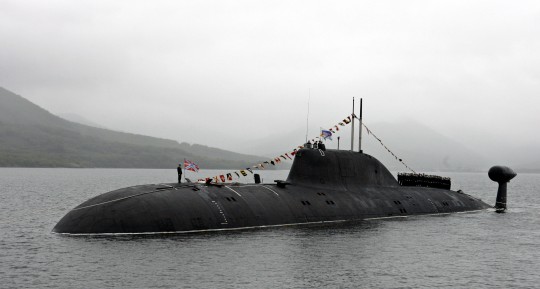
Russian attack sub patrolled Gulf of Mexico undetected for several weeks...and we only knew about after it left the region!

Was this news released deliberately to counter President Obama`s proposal to slash $1.3 billion from the defense budget for the Navy`s shipbuilding projects? It may seem so, but what does it say about our national defense and cost to our ballooning defense spending? (RSA)

Russian Akula Submarine / AP
Russian Akula sub, image credit: AP
Russian attack submarine sailed in Gulf of Mexico undetected for weeks, U.S. officials say
BY: Bill Gertz
Washington Free Beacon
August 14, 2012 

A Russian nuclear-powered attack submarine armed with long-range cruise missiles operated undetected in the Gulf of Mexico for several weeks and its travel in strategic U.S. waters was only confirmed after it left the region, the Washington Free Beacon has learned.

[...]

The officials who are familiar with reports of the submarine patrol in the Gulf of Mexico said the vessel was a nuclear-powered Akula-class attack submarine, one of Russia’s quietest submarines.

The fact that the Akula was not detected in the Gulf is cause for concern, U.S. officials said.

A Navy spokeswoman declined to comment.

One official said the Akula operated without being detected for a month.

“The Akula was built for one reason and one reason only: To kill U.S. Navy ballistic missile submarines and their crews,” said a second U.S. official.

“It’s a very stealthy boat so it can sneak around and avoid detection and hope to get past any protective screen a boomer might have in place,” the official said, referring to the Navy nickname for strategic missile submarines...

(click here to read the full article on the Washington Free Beacon)

Wednesday, May 23, 2012

Russia test fires AMD-piercing strategic missile (RT)

RT NEWS
Published: 23 May, 2012
Yars ICBM launch. The new secret missile improves its design. RIA Novosti
Yars ICBM launch. The new secret missile improves its 
design. Photo credit: RIA Novosti
The Russian military have successfully launched a top secret advanced intercontinental ballistic missile. It is designed to counter the American antimissile shield currently being deployed in several regions.

The new weapon is an advanced version of the Topol-M and Yars missiles, already deployed by the Russian Strategic Missile Forces. The experiment was boosted off from the Plesetsk launch site in north-western Russia’s Arkhangelsk region on Wednesday. It delivered its test block to the Kura target range in Kamchatka Peninsula in the Far East.


The main purpose of the launch was to confirm feasibility of the design approaches incorporated into the missile, spokesman for the Forces Colonel Vadim Koval told journalists.
The successful test comes after a failed launch of the prototype on September 27, 2011. At the time the missile’s first-stage engine reportedly failed, which resulted in it dropping some 10 kilometers from the launch pad.


The medium-weight ICBM is “one of the military-technical measures, which Russia’s military-political leadership is taking in response to the deployment of a global antimissile defense system by the Americans,” says retired Col.-General Viktor Yesin.

The new missile may be ready for service “soon” and would boost Russia’s nuclear deterrence “in the uncertain situation”, the former head the Strategic Missile Forces’ General Staff told Interfax news agency.


According to military sources, the upgraded design behind the new weapon focused on its fuel formula. The solid propellant has been improved and allows for a faster boost, shortening the initial phase of the flight. During the boosting phase the missile is relatively slow and predictable, which makes it more vulnerable to anti-missiles.

Little detail about the new ICBM has been revealed. Unofficially dubbed Avangard, it is expected to have a MIRV-ed warhead with improved maneuvering and targeting capabilities of the vehicles. Some reports say that rather than having a traditional “bus” delivering each warhead to its target, designers chose to equip them with individual engines. This would allow active maneuvering on the descent phase.

Silo-based and mobile launcher-mounted versions of the missile are currently in development.