





The words 'Soviet Union' here in America conjures up feelings of Stalinist pride, Lenin, the cold war, Red commies, over opulent Russian oligarchs and the KGB but...in fact no one ever thinks of the accomplishments made by USSR during the Soviet Era. - A personal favorite of mine is in terms of space exploration. We all know, if it wasn`t for the successes of Soviet Union in space, America and specifically NASA would have never got the foot off the ground. The once mighty USSR in its heyday heralded cutting edge technology of its time and the sheer scale of audacity surely dominated the eastern hemisphere and scared the West, who no undoubtedly 'rejoiced as its formidable enemy was brought to its knees.'
As can be seen recently in the past few years, Vladmir Putin, the current Russian President is bringing some of Russia`s 'Soviet Era' groove back. Russia has become a major power player and power broker in the shaky world of world politics; a force to reckon with now and forever. Its an ideal check to the 'global aspirations' of the West and EU nations. Russia has been delving into the forays into international politics, i.e. Syria, from preventing it becoming another 'Al-CIA-da' sponsored excursion like Libya? - On that note, do you see or hear ANY news on Libya on main-stream media? Well on the ground, its a much different story that no one cares about, the globalist media milked it and its onto the next conflict as they say.
Now, we`ve all heard the news reports of Russian long-range bombers buzzing US skies, or overseas territories, or over defense drills in the Pacific - (all to reiterate it was over international airspace) was spawned into vilifying Russia as an aggressor nation willing to 'challenge' the US with it`s saber rattling. Well, every nation has the right to defend itself and its self interests, and Russia is just re-starting the bomber flights since the Soviet era as their nuclear deterrent - as other countries similarly do.
Recently, it was reported Russian nuke subs will begin to patrol southern seas for first time since the Soviet era. Unofficial government sources stated “this would serve to solve the tasks of strategic nuclear deterrence not only across the North Pole but also the South Pole.” It was reported - "Starting from 2014, Russia is going to expand its strategic submarine patrol area of the World Ocean, a source in the Russian General Staff told Itar-Tass agency. The statement comes as the Russian Northern Fleet – the country’s most powerful – is celebrating the 80th anniversary since its foundation in 1933."
The nuclear-powered Borei-class submarines will form the core of Russia`s strategic submarine fleet. Each one is fitted with with 16 Bulava nuclear ICBMs with later models fitted with 20. The Borei is an advanced state-of-the-art sub compared to previous generations of submarines. Russia’s first Borei sub - the Yury Dolgoruky, was put into service in January this year with 2 more to come end of the year.
In simple words, this is Vladimir Putin saying, "Check!" As Mark Holland commented: "Russia, China and even Iran are once again showing their independence from the US,...but be careful while the US is not the giant it once was, a wounded lion is far more dangerous then a healthy one."
Showing posts with label nukes. Show all posts
Showing posts with label nukes. Show all posts
Sunday, June 2, 2013


Friday, April 5, 2013
The Unfair Biased Treatment of the DPRK (North Korea)
Putting the Squeeze on North Korea
By Gregory Elich
Global Research,
February 04, 2013
Tensions are escalating since North Korea’s launch of a satellite into orbit on December 12, 2012. Overwrought news reports termed the launch a “threat” and a “provocation,” while U.S. National Security Council spokesman Tommy Vietor called it “irresponsible behavior.” Punishment for North Korea was swift in coming.
North Korea’s Kwangmyongsong-3 was just one of 75 satellites that a variety of nations sent into space last year, but Pyongyang’s launch, and a failed launch earlier in the year on April 12, were the only ones singled out for condemnation. [1] In Western eyes, there was something uniquely threatening about the Kwangmyongsong-3 earth observation satellite, unlike the apparently more benign five military and three spy satellites the United States launched last year.
We are told that the Democratic People’s Republic of Korea (DPRK, the official name for North Korea) used the satellite launch to test ballistic missile technology. But the North Koreans could hardly have sent their satellite into orbit by slingshot. The Kwangmyongsong-3 was equipped with a camera intended to help assess the nation’s natural resources and forest distribution and to collect crop estimates. The Western press was quick to scoff at the satellite as having no rational economic purpose. Although the satellite failed to become operable, a common enough experience for nations putting their first satellite into space, the intent was to support much-needed ecological recovery in North Korea and to aid agricultural planning.
Specialists argue that the DPRK’s Unha-3 missile, used for the launch, is not a suitable candidate for delivering a nuclear warhead. According to analyst Markus Schiller of Schmucker Technologie in Germany, for North Korea to “become a player in the ICBM game, they would have to develop a different kind of missile, with higher performance. And if they do that seriously, we would have to see flight tests every other month, over several years.” [2] The North Korean missile “was developed as a satellite launcher and not as a weapon,” Schiller says. “The technology was suited only for satellite launch.” Brian Weedan, a space expert at the Secure World Foundation, agrees, and points out that the missile took a sharp turn to avoid flying over Taiwan and the Philippines. “That is definitely something more associated with a space launch than with a ballistic missile launch. It’s not what you would expect to see with a missile test.” [3]
The Unha-3 is simply too small for the job of delivering a nuclear warhead, even assuming that the DPRK had miniaturized a nuclear bomb, an endeavor requiring significant time and effort. The North Koreans would also need to develop a long-range guidance system and a reentry vehicle capable of withstanding the heat of returning through the atmosphere. Experts consider the DPRK to be years away from achieving such steps. [4]
In regard to North Korea’s satellite launches, Lewis Franklin and Nick Hansen of Stanford University’s Center for International Security and Cooperation remark, “The oft-repeated phrase ‘readily convertible to an ICBM’ posed by non-technical policy experts is engineering-wise unsupportable.” They explain that while other nations have utilized ICBMs for sending satellites into space, conversion of a light missile like the Uhha-3 into an ICBM “requires considerable redesign and testing, and no country has taken this route.” [5]
The other aspect of the launch that the U.S found so provocative was its violation of UN Security Council Resolution 1874 of June 12, 2009, which enjoined the DPRK from conducting “any launch using ballistic missile technology.” That resolution was prompted by a North Korean nuclear test. Yet, when Israel, Pakistan and India – all non-signatories to the Nuclear Non-Proliferation Treaty – not only performed testing, but proceeded to build substantial nuclear arsenals and missiles capable of delivering nuclear payloads, no action was forthcoming. This double standard has not gone unnoticed in the DPRK, which understands that the distinction between the North Korean case and that of Israel, Pakistan and India hinges on the latter three nations being U.S. allies, while for decades it has been the target of Western sanctions, threats and pressure.
Interestingly enough, India and Pakistan tested nuclear weapon-capable ballistic missiles at around the time of North Korea’s failed satellite launch on April 12, 2012. [6] The Indian and Pakistani missiles did not carry satellites; these were purely military tests, a fact which did not perturb the Obama Administration. Criticism was reserved for North Korea alone, while in regard to India’s test, U.S. State Department spokesman Mark Toner merely noted that the U.S. has a “very strong strategic and security partnership with India.” [7] Following Pakistan’s launch, U.S. State Department spokeswoman Victoria Nuland’s only comment was, “What’s most important is that they do seem to have taken steps to inform the Indians.” [8] These mild remarks contrasted with the vociferous abuse poured upon North Korea for its non-nuclear capable missiles carrying satellites.
Since the April ballistic missile launches, India and Pakistan have continued their tests, including India’s test of a nuclear-capable ballistic missile fired from underwater, part of its program to develop submarine-based nuclear missiles. [9] India conducted its underwater ballistic missile test on January 27, only a few days after the UN Security Council imposed sanctions on North Korea for putting a satellite into orbit.
When North Korea launched its satellite, India condemned the launch as “unwarranted,” and termed it an action adversely impacting peace and stability. [10] That same day, India test fired its nuclear-capable Agni-I ballistic missile, again without complaint by the U.S. [11] And just days after passage of the UN Security Council resolution against the DPRK, Japan put two spy satellites into space, both aimed at North Korea. [12] Not surprisingly, these missile launches evoked no complaint from U.S. officials.
South Korea successfully placed its own satellite into orbit on January 30, 2013, with the complete support of the U.S., which only added to North Korea’s growing sense of irritation over the blatant double standard. The hypocrisy is quite breathtaking. The U.S. sits atop the world’s largest nuclear arsenal, possesses the largest military machine on earth, regularly invades or bombs other nations, threatens nations who refuse to bend to its will, turns a blind eye to tests of ballistic missiles by India, Pakistan and Israel, and it condemns the small nation of North Korea for engaging in “provocative” behavior by sending a peaceful satellite into space.
The DPRK bears the distinction of being the only nation to have a UN Security Council resolution in effect banning it from launching a satellite. Yet, the international outer space treaty affirms that outer space “shall be the province of all mankind,” and that “Outer space, including the moon and other celestial bodies, shall be free for exploration and use by all States without discrimination of any kind.” [13] Note the language used here: “without discrimination of any kind.” This is absolutely unambiguous. The treaty does not say “except when the powerful choose to deny this right to a small nation.”
Western analysts argue that when a UN Security Council resolution contradicts international law, it is the resolution that takes precedence. That view makes a mockery of international law, which ceases to have any meaning when it can be discarded at will by imperial dictate.
The UN Charter tasks the Security Council to deal with matters relating to “threats to the peace, breaches of the peace, or acts of aggression.” The DPRK Central Committee of the Workers Party of Korea explains that its satellite launches for peaceful purposes “bear no relationship with the issues of international peace and security.” Moreover, the Security Council has never seen fit to take issue with such nations as the United States and Japan “that are speeding up militarization by launching innumerable spy satellites.” [14]
Sensing that the DPRK’s impending satellite launch would present a welcome opportunity, the U.S. started lining up support for imposing further sanctions on the DPRK well before the launch took place. Already the most heavily sanctioned nation on earth, North Korea’s economy could only suffer more damage from new sanctions. That was precisely the Obama Administration’s aim.
In anticipation of North Korea’s missile launch, South Korea under the ever-hostile administration of Lee Myung-bak, worked with other nations to identify the few remaining international bank accounts held by North Korea which had not yet been closed due to U.S. pressure. The hope was that North Korea could be completely blocked from engaging in international trade. The Lee Administration, too, perceived the missile launch as an opportunity to inflict further economic damage on its neighbor to the north. [15]
The Chinese advocated resuming the six-party talks, which were last held in December 2008. “China really believes that we ought to re-engage with North Korea,” U.S. Ambassador to China Gary Locke remarked, but “we don’t believe that we should be rewarding their bad behavior by sitting down and talking with them.” U.S. diplomats adamantly ruled out talks. During negotiations in December 2012, U.S. Ambassador to the UN Susan Rice bluntly told a Chinese diplomat that his nation’s resistance to additional sanctions was “ridiculous.” Rice demanded that North Korea face “consequences” for its satellite launch. [16]
U.S. officials are fond of saying that they will not reward the DPRK for its “bad behavior” by talking with its officials, but one cannot help but wonder: just whose behavior is bad? North Korean officials, whose nation exercised its right under international law and put a peaceful satellite into orbit, a right granted to all nations, and who want dialogue, or U.S. officials, who petulantly refuse to engage in negotiations, and who only know how to bully and intimidate?
The first task was to get China onboard with the concept of imposing new sanctions on its neighbor. High-ranking U.S. and South Korean diplomats met with their Chinese counterparts in Beijing on December 17, 2012. The Chinese opposed sanctions, preferring a prudent response. “The Chinese side repeated its stance that it wants to keep peace and stability on the Korean Peninsula,” a South Korean diplomatic source revealed. But the U.S. had “a strong willingness” to impose sanctions. “The U.S. is also sending a message to China that it will have no choice but to beef up its military readiness against North Korea’s threats unless a resolution is adopted at the U.N. Security Council.” [17]
The United States had already taken a number of steps to increasingly militarize its relations with South Korea in recent months, and it is probable that the threat to expand the U.S. military presence in the region finally persuaded the Chinese to back UN sanctions, despite their inevitable destabilizing effect. A U.S. military buildup in the region would serve a double purpose, aimed not only at North Korea but surely China as well. The Chinese were also keen to avoid straining relations with the U.S, an important trading partner.
Once the U.S. and South Korea won Chinese agreement for a UN Security Council resolution, the Obama Administration had a wish list of harsh measures that it wanted to implement via the resolution. U.S. State Department spokeswoman Victoria Nuland announced that the Obama Administration’s plan was “to continue to increase the pressure on the North Korean regime. And we’re looking at how best to do that, both bilaterally and with our partners going forward. Until they get the message, we’re going to have to continue to further isolate this regime.” Responding to a reporter who commented that North Korea “has long wanted direct talks with the U.S.,” and asked if the U.S. would consider that or stick to the six-party format, Nuland dismissively replied, “We and our partners are not in the business of rewarding them.” [18] There would be no talks of any kind.
U.S. negotiators insisted that the UN Security Council pass a resolution rather than a presidential statement, so that it would carry more force. Under pressure, the Chinese relented. The specific sanctions to be imposed were another matter. There the Chinese were more successful. The U.S. wanted to maximize the damage that would be inflicted on the North Korean people. Chinese Ambassador to the UN Li Baodong said, “The initial draft prepared by the UNSC contained a number of sanctions, but China believed that such measures would not be helpful in defusing the situation and would only cause harm to the North Korean economy and the lives of its people. As a result of more than a month of protracted negotiations, these provisions were removed from the final draft of the resolution.” [19]
UN Security Council resolution 2087 passed unanimously on January 22, 2013, ordering the DPRK to cease launching satellites, and that “any further such activities” would result in its “determination to take significant action.” A number of measures were imposed, including travel bans and asset freezes on specified individuals involved in the DPRK’s space program and banking officials assisting in its financial dealings. Asset freezes were also slapped on the North Korean Committee for Space Technology and North Korean banks and firms involved in the space program, essentially blocking those organizations from engaging in normal international financial transactions. [20]
The U.S. and South Korea immediately began planning further sanctions that they could impose on a bilateral basis. The U.S. had already stopped food aid to North Korea many months beforehand. Among the alternatives the U.S. and South Korea discussed were stepping up inspections of North Korean ships and ways to hamper North Korean ships from travelling near the Korean Peninsula. [21] The U.S. Treasury Department wasted little time in implementing its first set of bilateral sanctions, acting the day after passage of the UN Security Council resolution. It announced that all assets under U.S. control would be frozen held by two North Korean bankers and Hong Kong-based Leader International Trading Limited. [22]
South Korea had already revised its Public Order in Open Ports Act so that it required entry clearance for container ships having visited a North Korean port during the prior 180 days; an increase from the earlier 60 day limit. A South Korean official said that Seoul intended to target shipments into and out of the DPRK. “We are considering sanctions in marine transport. Now that we have already set the legal grounds, we will start talks with other countries over additional sanctions.” [23] The intention is to cut maritime supply routes to North Korea.
Pressure on North Korea is two-fold: economic sanctions and military presence. In the midst of UN Security Council deliberations, U.S. Secretary of Defense Leon Panetta called for the reorientation of NATO, to “broaden the scope of our alliance security discussions beyond European and regional issues.” The U.S. has led the expansion of NATO military operations first in its bombing operations in the Balkans, then later in Iraq, Afghanistan and Libya. The aim is for NATO to support aggressive U.S. military operations, across all continents that adjoin Europe and the Mediterranean. “In particular,” Panetta continued, “I strongly believe that Europe should join the United States in increasing and deepening defense engagement with the Asia-Pacific region…The bottom line is that Europe should not fear our rebalance to Asia; Europe should join it.” [24]
However, there is one thing one can say about the North Koreans. They are never cowed by imperial bullying.
Shortly before passage of the UN Security Council resolution, the DPRK sent a message to the United States, calling for negotiations to settle security concerns. That message apparently went unanswered. [25]
As soon as the UN resolution passed, the Foreign Ministry of the DPRK issued its response, stating that it “flatly rejects the unjust acts of the UNSC aimed at wantonly violating the sovereignty of the DPRK and depriving it of the right to launch satellites for peaceful purposes. The hostile forces are seriously mistaken if they think they can bring down the DPRK with sanctions and pressure.” The Foreign Ministry asserted that the “DPRK will continue to exercise its independent and legitimate right to launch satellites for peaceful purposes while abiding by the universally recognized international law on the use of space for peaceful purposes.” Furthermore, “the DPRK will continuously launch satellites for peaceful purposes.”
Noting that U.S. hostility remains unchanged, the DPRK Foreign Ministry concluded that “the prospect for denuclearization of the Korean Peninsula has become gloomier,” and so “there may be talks for peace and stability…but no talks for the denuclearization of the peninsula.” North Korea, it said, “will take steps for physical counteraction to bolster the military capabilities for self-defense, including nuclear deterrence…to cope with the evermore undisguised moves of the U.S. to apply sanctions and apply pressure against the DPRK.” [26] First a peace settlement must be reached; only then can talks on denuclearization can proceed.
Events on the Korean Peninsula are heading in a potentially dangerous direction. New sanctions on the DPRK and the refusal of the Obama Administration to engage in dialogue have eliminated any exit strategy. North Korea, feeling threatened, may conduct another nuclear test to further develop the best defense it has against military aggression and to assert its independence. However, South Korea promises “very grave consequences” if it follows that path. [27] The U.S. has made similarly threatening statements.
According to South Korean presidential national security advisor Chun Yung-woo, consequences must be imposed on the DPRK that it finds intolerable. North Korea must choose between nuclear weapons or its survival, he declared. “No other options must be allowed.” [28]
Ratcheting up pressure on the DPRK, the U.S. and South Korea kicked off joint naval military exercises in the East Sea on February 4, 2013, including the nuclear submarine USS San Francisco. “Through this joint military exercise, we will be able to deliver a message to North Korea that if they engage in a defiant act, it won’t be tolerated,” warned Jung Seung-jo, chairman of the South Korean Joint Chiefs of Staff. [29]
North Korea has always responded in kind. When approached diplomatically, it negotiates and when threatened, it resists. Neither the U.S. nor South Korea is open to dialogue at the present time. Both are bent on exacerbating tensions.
China is attempting to dissuade the DPRK from carrying out another nuclear test, aware of the dangers that U.S. and South Korean aggressive reaction could present. But even if North Korea refrains from conducting another nuclear test, it is clear that the U.S. is seeking a pretext – any pretext – to squeeze North Korea harder, and it may not take much to plunge the Korean Peninsula into a terrible crisis.
Gregory Elich is on the Board of Directors of the Jasenovac Research Institute and on the Advisory Board of the Korea Truth Commission. He is the author of the book Strange Liberators: Militarism, Mayhem, and the Pursuit of Profit.
http://www.amazon.com/Strange-Liberators-Militarism-Mayhem-Pursuit/dp/1595265708
Notes
[1] http://www.satelliteonthenet.co.uk/index.php/2012
[2] “Experts Say North Korea Still Years Away from Reliable Rockets,” Associated Press, December 12, 2012.
[3] Ken Dilanian, “Experts Debate North Korea’s Missile Goals and Capability,” Los Angeles Times, January 9, 2013.
[4] “Experts Say North Korea Still Years Away from Reliable Rockets,” Associated Press, December 12, 2012.
[5] Steven Haggard, “More on the Missile Test,” Peterson Institute for International Economics, March 19, 2012.
[6] Aleksandr Zakharovich Zhebin, “Pyongyang will Respond to the United Nations with a Nuclear Explosion: North Korea is Abandoning the Promises of Denuclearization,” Nezavismaya Gazeta, January 25, 2013.
[7] Heather Timmons and Jim Yardley, “Signs of an Asian Arms Buildup in India’s Missile Test,” New York Times, April 19, 2012.
[8] Sami Zubeiri, “Pakistan Tests Nuclear-Capable Ballistic Missile,” Agence France-Presse, April 25, 2012.
[9] “India Tests Underwater Ballistic Missile,” UPI, January 27, 2013.
[10] “India Terms North Korean Rocket Launch ‘Unwarranted,” Deccan Herald, December 12, 2012.
[11] “India Successfully Test-fires Agni-I Ballistic Missile,” Press Trust of India, December 12, 2012.
[12] Stephen Clark, “Japan Launches Spy Satellites into Orbit,” Space Flight Now, January 28, 2013.
[13] http://www.oosa.unvienna.org/oosa/SpaceLaw/outerspt.html
[14] Ri Hyon-to, “We Reject the UN Security Council ‘Resolution’ Fabricated Under US Initiative,” Rodong Sinmun, January 29, 2013.
[15] Kim Young-jin, “Seoul Seeks to Freeze NK Accounts,” Korea Times, December 5, 2012.
[16] “N. Korea Not Expected to See U.N. Penalties this Year for Rocket Launch,” Global Security Newswire, December 18, 2012.
“China Resists Moves to Sanction N. Korea: Diplomats,” Agence France-Presse, December 18, 2012.
[17] “U.S. Pressing China to Back U.N. Punishment for N. Korea: Source,” Yonhap, December 18, 2012.
[18] Victoria Nuland, Daily Press Briefing, U.S. Department of State, December 17, 2012.
[19] Park Min-hee, “What Made China Vote for UN Sanctions on North Korea?”, Hankoreh, January 24, 2013.
“China Says New UN Resolution on DPRK ‘Generally Balanced,’ Xinhua, January 23, 2013.
[20] UN Security Council SC/10891, “Security Council Condemns Use of Ballistic Missile Technology in Launch by Democratic People’s Republic of Korea, in Resolution 2087 (2013),” January 22, 2013.
[21] “S. Korea, U.S. Ponders ‘Additional Sanctions’ Against N. Korea,” Yonhap, January 23, 2013.
[22] Press Release, “Treasury Sanctions Company and Individuals Linked to North Korean Weapons of Mass Destruction Program,” U.S. Department of Treasury, January 24, 2013.
[23] Park Hyung-ki and Shin Hyon-hee, “S. Korea Analyzed Salvaged N. Korean Rocket Debris,” Korea Herald, December 14, 2012.
[24] Jorge Benitez, “Panetta: NATO Needs to Join U.S. Rebalance to Asia-Pacific,” Atlantic Council NATO Alliance News Blog, January 18, 2013.
[25] “N. Korea Sends ‘Ultimatum’ to U.S. on Nuke Issue: Newspaper,” Yonhap, January 21, 2013.
[26] “DPRK Refutes UNSC’s ‘Resolution’ Pulling Up DPRK over its Satellite Launch,” KCNA, January 23, 2013.
[27] “S. Korea Warns N. Korea Will Face ‘Grave Consequences’ in Case of Nuclear Test,” Yonhap, January 31, 2013.
[28 “S. Korea Calls for ‘Intolerable’ Sanctions Against N. Korea’s Nuke Ambition,” Yonhap, January 30, 2013.
[29] Jeong Yong-soo, “U.S. Sends Submarine to East Sea,” JoongAng Ilbo, February 2, 2013.
Park Byong-su, “Large South Korea-US Military Exercises to Involve Nuclear Submarine,” Hanyoreh, February 2, 2013.
Copyright © Gregory Elich, Global Research, 2013
Saturday, July 7, 2012
Israeli PM involved in nuke trigger smuggling from the US
Netanyahu involved in smuggling nuke triggers: Report
Press TV
Jul 7, 2012
Israeli Prime Minister Benjamin Netanyahu was involved in smuggling nuclear triggers out of the United States carried out by a network of front companies, a report says.
According to a Wednesday article posted on antiwar.com, the FBI partially declassified and released additional pages from a 1985-2002 investigation into how a network of front companies connected to the Israeli Ministry for Military Affairs illegally smuggled triggers used for nuclear weapons (krytrons) out of the United States.
The FBI investigation reveals that Netanyahu worked at Heli Trading Company,
the Israeli node of the network during the smuggling operations.
The Israeli premier was in contact with Richard Kelly Smyth, who at the time was president of the MILCO International Inc., a front company for the Israel-based Heli Trading Company, then owned by Hollywood producer Arnon Milchan.
In April 2002, Smyth was sentenced to 40 months in prison and fined 20,000 dollars for trafficking krytrons, tiny electronic devices that are used in high-speed photography, strobe lighting and photocopying machines, but can also be used in nuclear triggers.
Smyth was also indicted for selling about 800 krytrons to Heli Trading Company (also known as Milchan Limited).
“Smyth and [Netanyahu] would meet in restaurants in Tel Aviv and in [Netanyahu’s] home and/or business,” the FBI report said.
In March, the co-authors of the book Confidential: The Life of Secret Agent Turned
Hollywood Tycoon Arnon Milchan issued a statement saying, “Hollywood mega-
producer and former secret agent Arnon Milchan has been asked directly by Israeli
Prime Minister Benjamin Netanyahu and President Shimon Peres to avoid any
public discussion of the book Confidential, asserting that the matter is too
sensitive at this time.”
HSN/MA/IS
Press TV
Jul 7, 2012
 |
| Israeli Prime Minister Benjamin Netanyahu. Credit: PressTV |
According to a Wednesday article posted on antiwar.com, the FBI partially declassified and released additional pages from a 1985-2002 investigation into how a network of front companies connected to the Israeli Ministry for Military Affairs illegally smuggled triggers used for nuclear weapons (krytrons) out of the United States.
The FBI investigation reveals that Netanyahu worked at Heli Trading Company,
the Israeli node of the network during the smuggling operations.
The Israeli premier was in contact with Richard Kelly Smyth, who at the time was president of the MILCO International Inc., a front company for the Israel-based Heli Trading Company, then owned by Hollywood producer Arnon Milchan.
In April 2002, Smyth was sentenced to 40 months in prison and fined 20,000 dollars for trafficking krytrons, tiny electronic devices that are used in high-speed photography, strobe lighting and photocopying machines, but can also be used in nuclear triggers.
Smyth was also indicted for selling about 800 krytrons to Heli Trading Company (also known as Milchan Limited).
“Smyth and [Netanyahu] would meet in restaurants in Tel Aviv and in [Netanyahu’s] home and/or business,” the FBI report said.
In March, the co-authors of the book Confidential: The Life of Secret Agent Turned
Hollywood Tycoon Arnon Milchan issued a statement saying, “Hollywood mega-
producer and former secret agent Arnon Milchan has been asked directly by Israeli
Prime Minister Benjamin Netanyahu and President Shimon Peres to avoid any
public discussion of the book Confidential, asserting that the matter is too
sensitive at this time.”
HSN/MA/IS
Friday, April 6, 2012
U.S. does a double-take: Obama messages Khamenei he is willing to accept civilian nuclear program in Iran provided no nuclear bombs be developed
'Obama signaled to Khamenei that U.S. could accept civilian nuclear program in Iran'
Washington Post's David Ignatius says U.S. president passed a message to Iran, through Turkish PM Erdogan, that he could agree to a civilian nuclear program if Tehran proved it was not building a nuclear bomb.
By Barak Ravid
Haaretz
March 6, 2012
U.S. President Barack Obama has recently passed a message to Iran's Supreme Leader Ayatollah Ali Khamenei, the Washington Post reported on Friday, which signaled that the United States would agree to an Iranian civilian nuclear program if they proved they were not developing a nuclear bomb.
According to David Ignatius, the Washington Post's senior columnist specializing in intelligence matters, Obama passed Khamenei the message through Turkish Prime Minister Recep Tayyip Erdogan, who visited Tehran this week.
Obama reportedly signaled Khamenei that the U.S. would be prepared to accept a civilian nuclear program in Iran, should the Iranian leader take steps that would support his public declarations in February, in which he said that Iran "would never develop nuclear weapons." The U.S., Obama also wrote, would also expect Iranian leaders to prove that Tehran does not have a military nuclear program.
Obama met with Erdogan at the nuclear summit in South Korea for two hours and asked him to pass on the message to Khamenei. Obama told Erdogan that the Iranians must understand that time is running out on a solution for the Tehran nuclear problem and that they must take advantage of the negotiations that will begin with the six world powers on April 13.
According to Ignatius, Obama did not give details as to whether Iran would be allowed to continue enriching uranium on its soil while developing its civilian nuclear program.
Erdogan told Obama that he will transfer the message, and the U.S. administration believes that he did so during the meeting he held with Khamenei in Tehran this week.
Since Obama entered the White House, an alliance was formed between him and Erdogan. The Turkish prime minister is the Muslim leader that is most closely associated with the U.S. president.
Negotiations between Iran and the six world powers are due to begin on April 13, but a location has yet been scheduled.
Related:
Exclusive: What were the six points Obama sent Khamenei through Erdogan?
Washington Post's David Ignatius says U.S. president passed a message to Iran, through Turkish PM Erdogan, that he could agree to a civilian nuclear program if Tehran proved it was not building a nuclear bomb.
Haaretz
March 6, 2012
According to David Ignatius, the Washington Post's senior columnist specializing in intelligence matters, Obama passed Khamenei the message through Turkish Prime Minister Recep Tayyip Erdogan, who visited Tehran this week.
 |
U.S. President Barack Obama (R) shakes hands
with Turkey's Prime Minister Tayyip Erdogan after a
bilateral meeting in Seoul March 25, 2012.
Photo by: Reuters
|
Obama met with Erdogan at the nuclear summit in South Korea for two hours and asked him to pass on the message to Khamenei. Obama told Erdogan that the Iranians must understand that time is running out on a solution for the Tehran nuclear problem and that they must take advantage of the negotiations that will begin with the six world powers on April 13.
According to Ignatius, Obama did not give details as to whether Iran would be allowed to continue enriching uranium on its soil while developing its civilian nuclear program.
Erdogan told Obama that he will transfer the message, and the U.S. administration believes that he did so during the meeting he held with Khamenei in Tehran this week.
Since Obama entered the White House, an alliance was formed between him and Erdogan. The Turkish prime minister is the Muslim leader that is most closely associated with the U.S. president.
Negotiations between Iran and the six world powers are due to begin on April 13, but a location has yet been scheduled.
Related:
Exclusive: What were the six points Obama sent Khamenei through Erdogan?
Thursday, April 5, 2012
German Nobel laureate: Nuclear Israel is a threat to world peace
German Nobel laureate Guenter Grass' new poem: Nuclear Israel is a threat to world peace
Grass publishes a poem criticizing Israel's role in the Israel-Iran conflict; Israel embassy in Germany says poem is 'blood libel.'
By Ofer Aderet
Haaretz
April 4, 2012
German Nobel literature laureate Guenter Grass published a poem Wednesday in which he said that Israel's nuclear program is a threat to world peace.
In his poem, the 85-year-old author claims that Israel’s nuclear reactor – and not Iran’s – presents a threat to world peace. Grass’ poem calls for Germany to cease supplying Israel with submarines, and warns against an Israeli strike on Iran.
The poem, entitled “What must be said,” will be published on Wednesday in the Deutsche Zeitung and La Republica. In the poem, Grass writes that Iranian President Mahmoud Ahmadinejad has a “big mouth,” and that the intentions of the Iranian nuclear program are not proven.
The poem drew sharp criticism in Germany, Israel and among Jewish organizations. The Israeli embassy in Germany said that the poem was in line with the 'tradition of blood libel ahead of Passover."
Read Guenter Grass' poem in German
Grass also claims that “Israel’s nuclear potential has been stealthily growing for years,” without being under any kind of international supervision. Grass believes that Israel is planning to arm submarines recently purchased from Germany with nuclear warheads.
“Germany could be responsible for a crime that can be foreseen," Grass said.
Grass achieved fame with his first novel “The Tin Drum.” Many of his stories have been translated into Hebrew and English. In 2006, Grass admitted for the first time to serving in Hitler's Waffen SS during the Second World War. Today, Grass is an active member of the Social Democratic Party of Germany.
Grass publishes a poem criticizing Israel's role in the Israel-Iran conflict; Israel embassy in Germany says poem is 'blood libel.'
Haaretz
April 4, 2012
German Nobel literature laureate Guenter Grass published a poem Wednesday in which he said that Israel's nuclear program is a threat to world peace.
 |
| Guenter Grass, photo credit: Reuters |
The poem, entitled “What must be said,” will be published on Wednesday in the Deutsche Zeitung and La Republica. In the poem, Grass writes that Iranian President Mahmoud Ahmadinejad has a “big mouth,” and that the intentions of the Iranian nuclear program are not proven.
The poem drew sharp criticism in Germany, Israel and among Jewish organizations. The Israeli embassy in Germany said that the poem was in line with the 'tradition of blood libel ahead of Passover."
Read Guenter Grass' poem in German
Grass also claims that “Israel’s nuclear potential has been stealthily growing for years,” without being under any kind of international supervision. Grass believes that Israel is planning to arm submarines recently purchased from Germany with nuclear warheads.
“Germany could be responsible for a crime that can be foreseen," Grass said.
Grass achieved fame with his first novel “The Tin Drum.” Many of his stories have been translated into Hebrew and English. In 2006, Grass admitted for the first time to serving in Hitler's Waffen SS during the Second World War. Today, Grass is an active member of the Social Democratic Party of Germany.
Thursday, March 1, 2012
Wow, Netanyahu DEMANDS Obama to commit to Iran War
Israeli PM demands Obama commit to military action if Iran sanctions fail
Binyamin Netanyahu pressing for explicit threat from US ahead of crucial meeting with Obama next week in Washington
Chris McGreal
The Guardian
Thursday 1 March 2012 12.43 EST
(Washington) Israel is pressing Barack Obama for an explicit threat of military action against Iran if sanctions fail and Tehran's nuclear programme advances beyond specified "red lines".
Binyamin Netanyahu, the Israeli prime minister, is expected to raise the issue at a White House meeting on Monday after weeks of intense diplomacy in which Obama has dispatched senior officials – including his intelligence, national security and military chiefs – to Jerusalem to try and dampen down talk of an attack.
Diplomats say that Israel is angered by the Obama administration's public disparaging of early military action against Iran, saying that it weakens the prospect of Tehran taking the warnings from Israel seriously.
The two sides are attempting to agree a joint public statement to paper over the divide but talks will not be made easier by a deepening distrust in which the Israelis...
(Click here to read the full article)
Binyamin Netanyahu pressing for explicit threat from US ahead of crucial meeting with Obama next week in Washington
The Guardian
Thursday 1 March 2012 12.43 EST
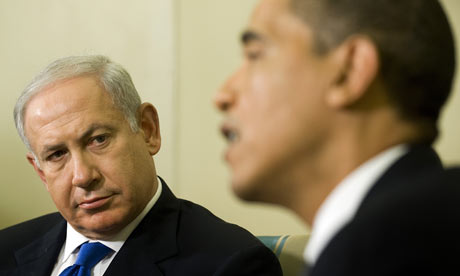 |
Israeli officials say that Binyamin Netanyahu is not happy with Obama`s
'vague assertion' that all options are on the table in dealing with Iran.
Photograph: Jim Watson/AFP/Getty Images
|
Binyamin Netanyahu, the Israeli prime minister, is expected to raise the issue at a White House meeting on Monday after weeks of intense diplomacy in which Obama has dispatched senior officials – including his intelligence, national security and military chiefs – to Jerusalem to try and dampen down talk of an attack.
Diplomats say that Israel is angered by the Obama administration's public disparaging of early military action against Iran, saying that it weakens the prospect of Tehran taking the warnings from Israel seriously.
The two sides are attempting to agree a joint public statement to paper over the divide but talks will not be made easier by a deepening distrust in which the Israelis...
(Click here to read the full article)
Wednesday, February 29, 2012
Is there more than meets the eye with North Korea`s sudden and recent agreement to freeze uranium enrichment for food aid?
 |
* FILE ** North Korea’s spent nuclear fuel rods, kept
in a cooling pond, are seen at the nuclear facilities in
Yongbyon, North Korea, about 60 miles north of the
capital, in this 1996 photo released by South Korea’s
Yonhap News Agency in 2003. (AP Photo/Yonhap
News Agency, File)
|
Washington Times
Wednesday, February 29, 2012
In exchange, the United States has agreed to deliver a significant food-aid package to North Korea.
The announcement marks a new step in the tense relations between the West and North Korea following the death late last year of longtime North Korean dictator Kim Jong-il.
His passing set in motion an uncertain transfer of power to his son, 27-year-old Kim Jong-un, who is slated to become the youngest person to head a nation with nuclear weapons.
While the State Department took care not to characterize the agreement as a quid pro quo, Ms. Nuland said U.S. officials have agreed to meet with representatives from Pyongyang.
They will “finalize administrative details necessary to move forward with our proposed package of 240,000 metric tons of nutritional assistance along with the intensive monitoring required for the delivery of such assistance,” she said.
The sudden concessions by Pyongyang, and agreement by the United States arrives on the heals of a meeting last week in Beijing between Glyn Davies, the U.S. special representative for North Korea policy, and Kim Kye-gwan, North Korea’s first vice foreign minister.
U.S. officials also reaffirmed that Washington has no “hostile intent toward” North Korea and “is prepared to take steps to improve our bilateral relationship in the spirit of mutual respect for sovereignty and equality,” Ms. Nuland said.
“The United States still has profound concerns regarding North Korean behavior across a wide range of areas, but today´s announcement reflects important, if limited, progress in addressing some of these,” she said.
The Feb. 23 meeting in Beijing also signaled the first thaw in relations toward Pyongyang since six-nation talks with North Korea broke down after the communist government violated a 2005 agreement to abandon its pursuit of nuclear weapons in exchange for aid and security guarantees.
The six-nation talks — involving the United States, Russia, China, Japan and North and South Korea — were declared effectively dead in 2009 when North Korea claimed to have successfully created an underground nuclear explosion.
RT News (02/29/12) on N. Korea`s recent statement to freeze enrichment for food aid:
Read/Additional Info:
N. Korea to halt nuke enrichment, missile tests - US (RT News, Feb 29, 2012)
Subscribe to:
Posts (Atom)